


Best ZIP Screen Options for Pergolas: Manual or Motorized?
Adding a ZIP screen to a pergola involves more than choosing fabric or color. The functionality of the screen affects the use of the space on a daily basis. A manually operated screen uses a hand crank and doesn’t rely on a power source, while motorized ZIP screens use powered controls for quick adjustment and can move multiple screens simultaneously.
Both screen types operate on the same principle of the ZIP screen – the outdoor fabric moves within closed aluminum side tracks, stays aligned, and is rolled into the protective cassette while being raised. Therefore, the decision on the type of screen to choose should not necessarily be based on the choice of the best technology, but on the number of screens to be installed, their frequency of movement, preferred control methods, and availability of power supply.
LOUSOL Aluminum Pergola designs aluminum louvered pergola systems in Canada and produces ZIP screens for pergolas in both manual and motorized versions. The following guide compares the two options, taking into account the above-mentioned considerations.
Quick Answer: The manual ZIP screens would be ideal if you had a single screen or a few screens, needed to operate them infrequently, and did not need a power source. Motorized pergola screens are better if you have several screens or pergola openings that need frequent adjustments and you want the convenience of remote control.
[Show/Hide]
TL;DR
- The manually operated ZIP screen uses a hand crank and does not need a power connection.
- Motorized outdoor screens use a motor and include remote controls; LOUSOL also mentions a mobile app and Google Assistant control for its motorized screen system.
- When it comes to a screen that remains stationary most of the time, motorized screens are usually unnecessary.
- If multiple screens need to move throughout the day, motorized controls make sense.
- Determine power routing and control zones before installing motorized screens.
- A ZIP screen helps provide shade, privacy, insect protection, and some protection from wind, but it cannot be considered a permanent solid wall or storm enclosure.
The louvered roof manages everything that occurs above the pergola. However, much of the discomfort can occur from the sides. The low-angle sun in the morning or late afternoon can shine through beneath the roofline. Neighboring houses may be a privacy concern. The insects may make dinner under the sky uncomfortable in the evening. Wind could also move any loose blinds outside.
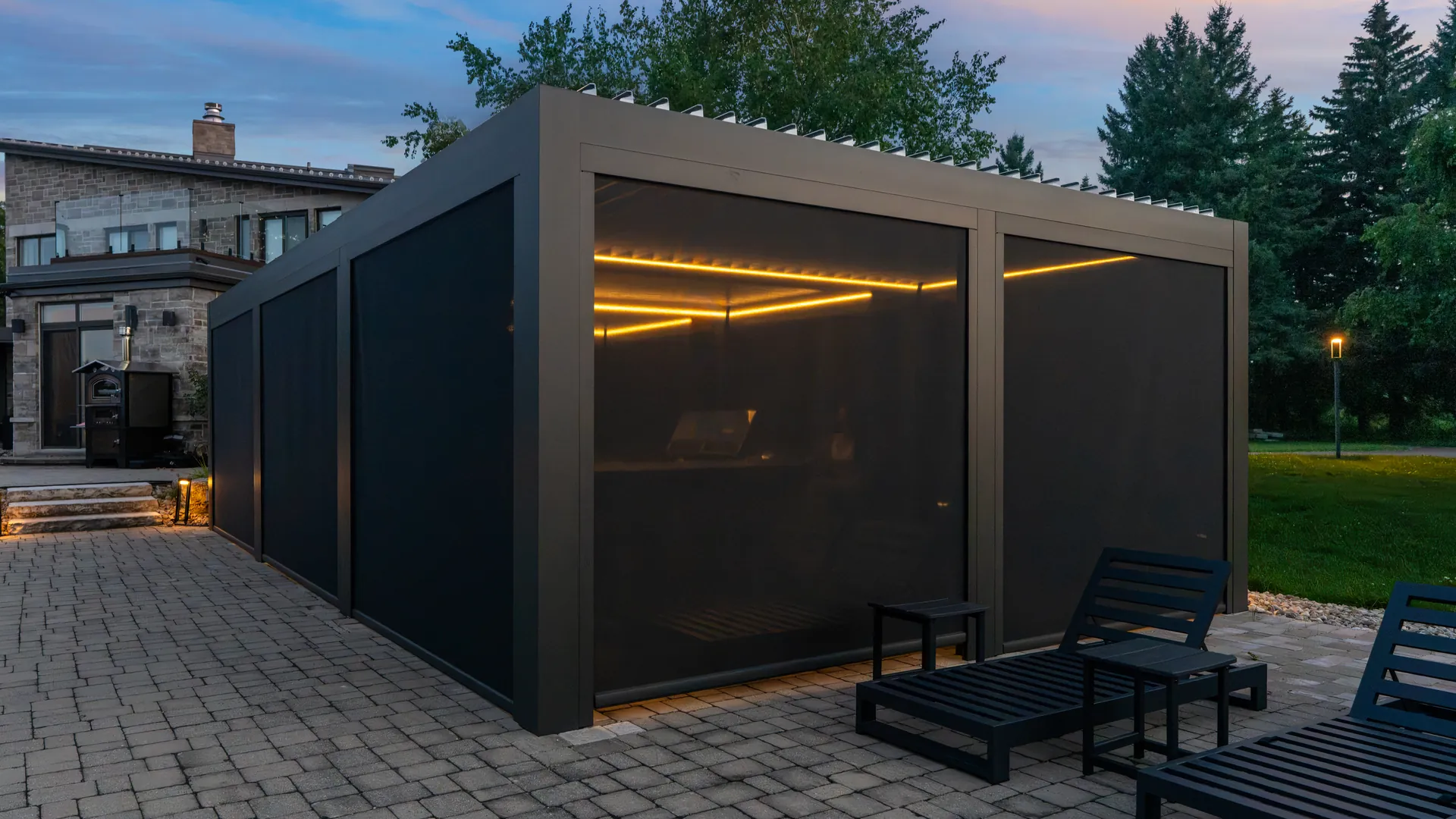
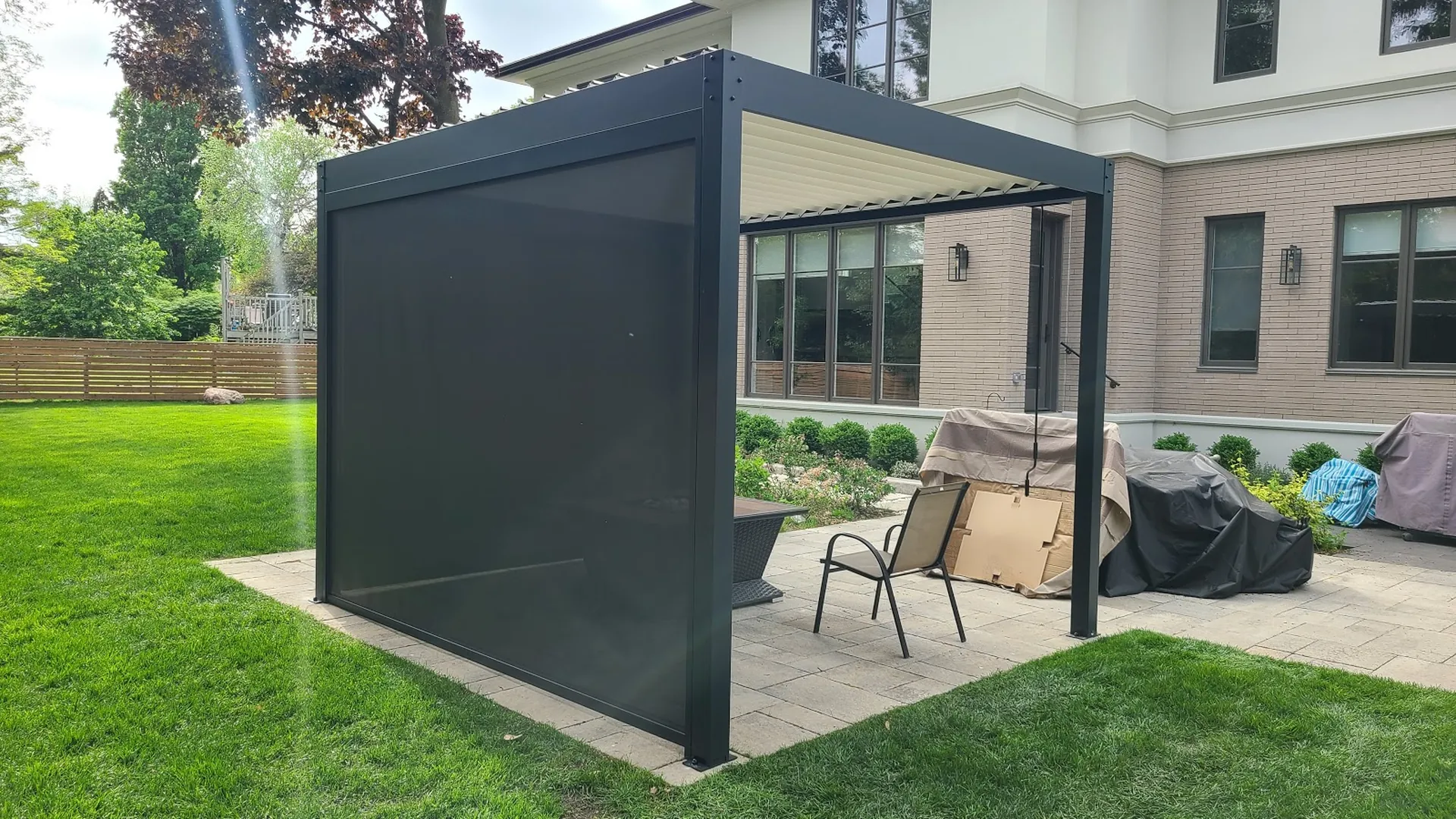
This is where the retractable pergola screens come in. In this case, the term “retractable” refers to the vertical screen material rolling up into the cassette. It is not about a retraction of the roof of the pergola. LOUSOL’s aluminum louvered roof operates with rotating louvers. Meanwhile, their ZIP screen is a separate accessory for sides.
Manual retractable screens keep things simple and without power. Motorized retractable screens allow for easy management of multiple sides. But again, the right choice depends on the opening dimensions, the number of screens, control needs, power, maintenance access, and use.
Manual vs Powered ZIP Screens at a Glance
Quick Answer: The manual ZIP screens employ a hand crank, which does not require any electricity. Motorized retractable screens use powered controls, and according to LOUSOL, you can operate them via remote, mobile app, and Google Assistant. The major differences between the buyers are the control type, power supply, ease of operation, and frequency of movement.
While the main point of differentiation is the means of operation, this will influence the actual use on a day-to-day basis. In both cases, the screens will move fabric along the edges of the opening and deposit it into a cassette when being raised. For manual operation, the screens move via a crank; for motorized operation, they move using electric controls. What matters here is the extent to which one will need to interact with the screen. This screen lowered once and left there will require little effort. This screen moving according to sun position or privacy needs will require a lot of changes.
| Decision Factor | Manual ZIP Screen | Motorized ZIP Screen |
|---|---|---|
| Operation | Hand crank | Powered motor |
| Power required | No | Yes |
| Main controls | Physical crank | Remote; LOUSOL also lists app and Google Assistant control |
| Everyday convenience | Practical for occasional adjustment | Practical for frequent or repeated adjustment |
| Multi-screen use | Each screen is operated manually | Screens can be programmed for individual or grouped operation |
| Best fit | Simpler, power-free setups | Frequent-use or multi-screen setups |
| Early planning need | Opening, mounting, access | Opening, mounting, access, power, wiring, and control plan |
How Pergola ZIP Screens Retract and Stay Aligned
Retractable pergola screens use a ZIP system in which the fabric edges are held captive in side tracks.
The key components of a ZIP screen are:
- Fabric – shade, privacy, ventilation, and bug exclusion based on the choice of fabric.
- Side tracks – guide the fabric and minimize side gaps and unnecessary movement.
- Bottom bar – controls the bottom edge as the screen moves.
- Top cassette – holds the lifted fabric.
- Drive mechanism – manually operated crank or an electric motor.
“ZIP” refers to how the fabric is guided by the side tracks. “Manual” or “motorized” refers to how the fabric moves. Electric motors modify how the screen moves, but they do not alter the basic principles of ZIP tracks.
Manual Outdoor Screens: How They Operate
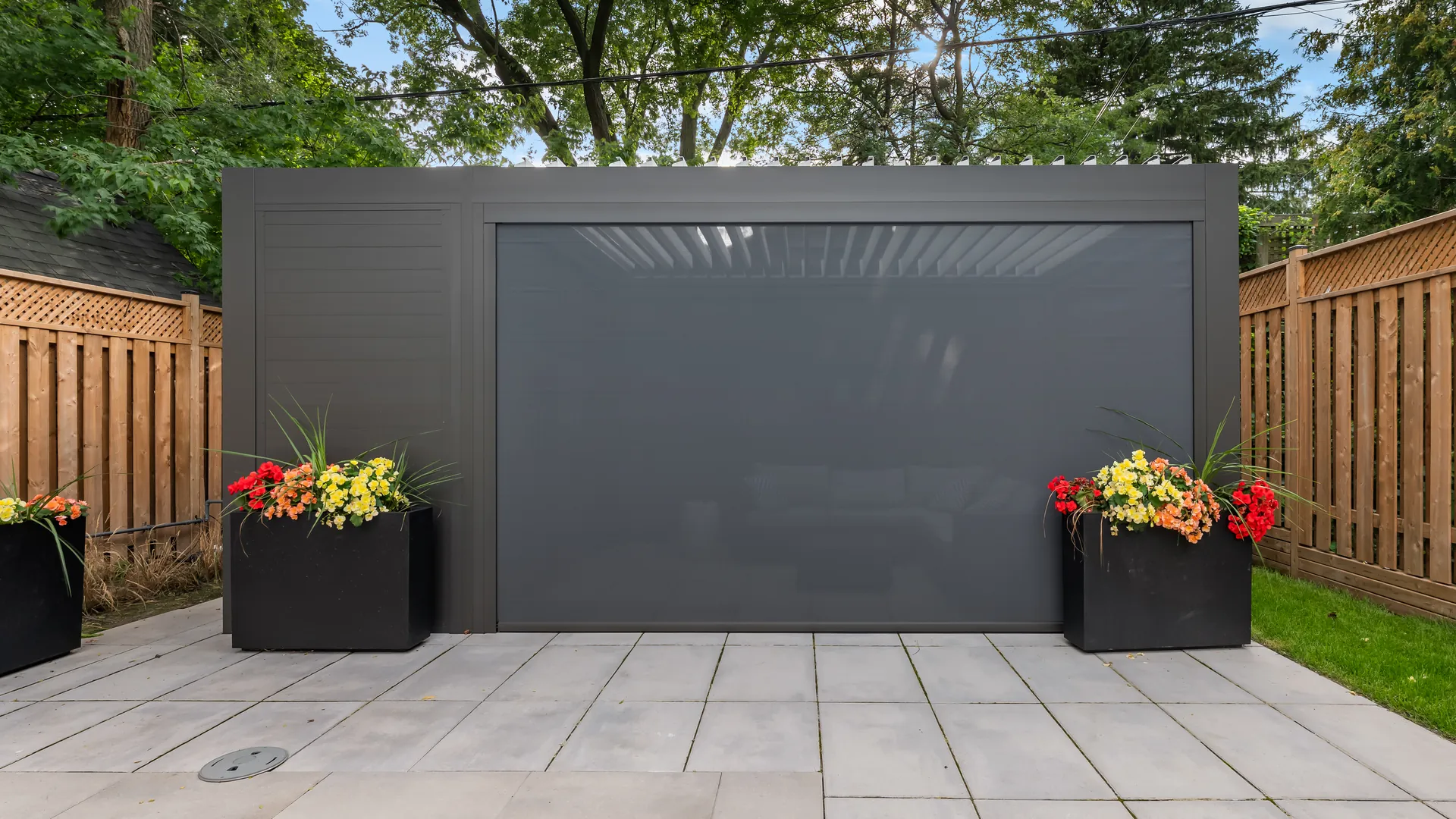
LOUSOL’s manual retractable screens use a hand-crank mechanism and do not require electricity to operate. They should be installed if the layout is clear-cut and the screen is not going to be moved constantly.
Manual operation is particularly important when:
- pergola is equipped with one or a few screened openings;
- screen stays up or down for prolonged periods of time;
- hand cranking is comfortable;
- control from a distance or group control is unnecessary.
This system has its pros and cons: every change should be carried out right by the screen. It is not very difficult for one screen that provides afternoon shading, but it gets trickier if there are several screens that keep moving throughout the day. LOUSOL’s standard 10×12 aluminum pergola KIT features a manual ZIP-screen option.
Motorized ZIP Screens: How They Operate
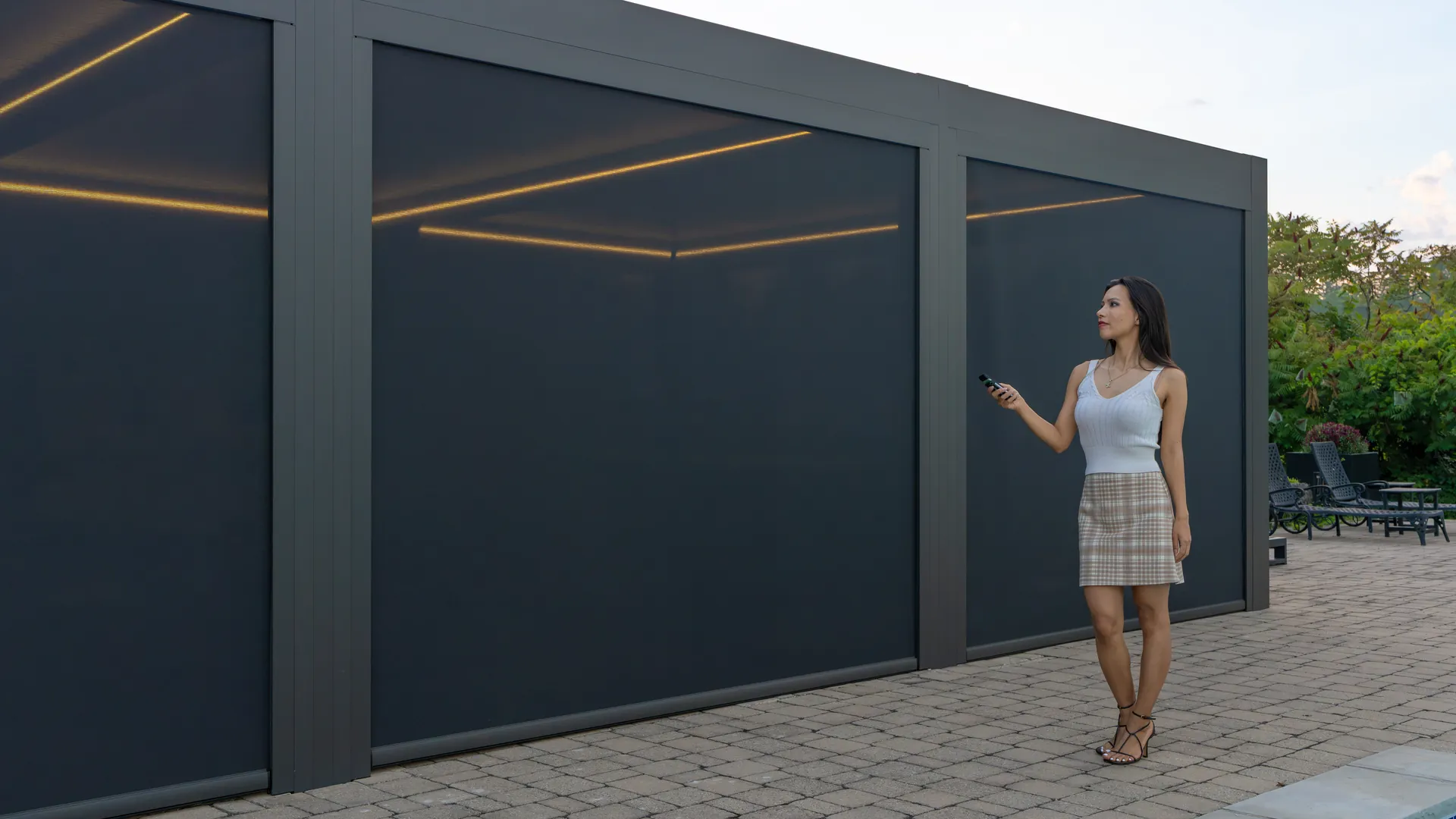
Motorized pergola screens use motorization instead of a hand-driven crank mechanism. LOUSOL points out Somfy-powered motorization of pergola screens and mentions remote control, mobile app control, and Google Assistant control options. You can also program individual or grouped screens.
Motorization matters the most in cases where:
- There are screens on several pergola sides;
- Several adjustments are needed throughout the day;
- Quick changes in privacy and shading are helpful;
- Grouping screens lowers the number of operations;
- Remote control is more convenient.
The additional condition here would be electrical engineering. Appropriate power sources and control equipment need to be prepared in advance. Since LOUSOL doesn’t provide information about the single-motorization feature set for every pergola project, the features of certain Somfy motors shouldn’t be taken into account unless specified for a certain case.
Best Option by Priority: The Short Answer
If simplicity and operation without a power source are the key priorities, choose the manual option. In case regular adjustments and multiple screens are required, motorized screens can be the solution. Finally, if app control or voice activation is important, the motorized option will come into play.
Screen size cannot serve as a decisive factor all by itself. A large screen that stays down most of the time may suit manual operation, while a smaller one with many sides adjusted regularly can benefit from motorization.
How to Evaluate LOUSOL Pergola ZIP Screen Options
Quick Answer: Use four primary criteria to assess a LOUSOL ZIP screen: how often it will be moved, how it should be controlled, whether there is proper power supply, and how the screen matches the physical space. Compare maintenance and usage in weather conditions as well as warranties. This way of proceeding ensures that the decision remains tied to actual use, and not based solely on preference of type.
An effective specification begins with the use of the space rather than the control technology. Establish what the purpose of each screen needs to be, how often it will need to move, who will control it, and if the opening will be able to accommodate the configuration needed. Also consider installation implications, since motorized screens need power and control, while manual outdoor screens need easy access to the crank mechanism. Maintenance and seasonal considerations are important too since both systems have fabric, side tracks, cassette, and mechanical parts.
| Evaluation Criterion | What to Check | Why It Matters | Manual Implication | Motorized Implication |
|---|---|---|---|---|
| Frequency of use | How often the screen moves | Determines value of powered convenience | Works well for occasional changes | More useful as movement frequency rises |
| Control preference | Crank vs remote/app/voice | Changes daily interaction | Direct physical operation | Remote and smart-control options |
| Power | Availability and routing | Required for powered operation | Not required | Must be planned |
| Opening layout | Width, height, screen count | Affects fit and control zones | Each screen operated at the opening | Can support individual/grouped control |
| Maintenance | Cleaning and service access | Affects long-term usability | Mechanical access required | Mechanical plus powered-component access |
| Weather use | Ice, snow, wind exposure | Affects when screens should be operated | Follow screen-use guidance | Same, plus power-off cleaning guidance |
Start With How Often the Screen Will Move
The frequency of usage is one of the most effective decision-makers in that it makes the question “Is automation required?” practical. Consider your regular week:
- Mostly down or mostly up – manual control may be adequate.
- Adjusted once a day – both variants are possible depending on the convenience preferences.
- Moved several times a day – motorization starts being more justified.
- Several screens to be moved at the same time – powered control of several screens makes more sense.
The principle is simple: the more frequently screens move, the more useful powered control is. However, frequent use does not make motorization strictly necessary.
Check Power and Control Requirements Early
Consider motorized retractable screens in the electrical planning process before finalizing finishes and accessory plans. This includes confirming:
- Where an appropriate power source is located;
- How wiring connects to each motorized screen;
- If screens can be operated independently, in groups, or both;
- The interaction between motorized screens and any lighting, heaters, or motorized louvers;
- Who is going to complete any necessary electrical work.
Outdoor permanent electrical work in Ontario needs to comply with the Ontario Electrical Safety Code. The Electrical Safety Authority has warned against permanent use of extension cords for outdoor power supply; please refer to their outdoor electrical safety guidelines.
Before purchasing motorized screens, confirm power availability and control options.
Measure Opening Size, Screen Count, and Layout
The current custom LOUSOL screens are approximately 4-20 feet wide and 4-14 feet tall, but the size of the screen is created for the opening itself. The final size is still dependent on the structure itself.
For each side, you need to look at:
- Opening dimensions in width and height;
- Number of sides to be screened;
- Posts and other structural features;
- Furniture and pathways; and
- Whether the screens need to operate independently or together.
The custom aluminum pergolas of LOUSOL offer more configuration options, while the KIT is pre-set in size and currently offers the manual ZIP-screen option.
Compare Maintenance, Warranty, and Weather Use
Cleaning of ZIP screens is suggested to be done using soft wet sponges and non-abrasive, water-based solutions at home. When cleaning motorized screens, the power needs to be shut off prior to the cleaning process. LOUSOL also warns against the use of screens when snow or ice has gathered on the structure.
According to the current warranty on LOUSOL’s pergolas, the ZIP-screen frame and fabric will be under warranty for 5 years while Somfy motorization and electronics will be under warranty for 2 years.
Which ZIP Screen Fits Your Pergola and Use Case?
Quick Answer: In general, manual outdoor screens work best when you need fewer screens, don’t adjust them often, and don’t need electricity. Motorized screens tend to make more sense when there are more screens, more frequent adjustments, or remote control is required. New pergola installations make it possible to consider electrical access right from the beginning.
“Best” varies based on the intended application, so analyze the system’s performance relative to how the pergola will be used. A single screen that stays stationary for most of the day presents a control challenge unlike three screens, which adapt to changes in sun exposure, privacy, or entertainment. A new installation allows greater flexibility regarding coordination of screens, wiring, post locations, and other accessories, whereas renovation will place more emphasis on compatibility and wiring capabilities. This is not about automating the process to the fullest extent possible. Rather, it is about making sure that the chosen operation type is feasible after installation.
| Scenario | Main Priority | Manual Fit | Motorized Fit | Verify Before Ordering |
|---|---|---|---|---|
| One screen, occasional shade | Simplicity | Strong | Optional | Opening size, crank access |
| Several screens | Easier operation | Possible but repetitive | Strong | Power and control grouping |
| Screen moved many times daily | Convenience | Less convenient | Strong | Power, control method |
| Screen stays mostly lowered | Privacy/shade | Strong | Optional | Fabric/view preference, opening |
| Existing pergola retrofit | Compatibility | Often possible | Possible if power can be planned | Structure, mounting, dimensions, wiring |
| New custom pergola | Integrated design | Available | Strong where automation is desired | Full accessory/electrical plan |
One Screen vs Several Pergola Openings
The number of screens changes the operating process. One manual screen for afternoon sun will need to be adjusted just once. Screens that change throughout the day need to be operated separately each time.
The following general recommendation can be made:
- One screen, rarely repositioned: manual is sufficient.
- One screen, frequently repositioned: motorized screens might be worth it.
- Many screens, rarely repositioned: manual option works well.
- Many screens, frequently repositioned: motorized option is becoming more useful.
- Frequently repositioning many screens: motorized option is obviously convenient.
LOUSOL says motorized screens can be used individually or collectively; such a setup is especially suitable for multi-sided pergolas.
Occasional Adjustment vs Everyday Operation
Often, daily behavior counts more than the details in a specification. If the privacy screen is going to remain down for most of the summer, it is easy to adjust using a crank. Similarly, a privacy screen that comes down when the west sun hits the dining area would require adjustment once.
The more compelling argument for the use of motorization happens when the pergola is constantly moving from being used for open-air use, dining, shade, insect barrier, and access. This also applies to communal areas where employees have to adjust screens multiple times a day.
Count how many times the screens move in a day to get a better measure of convenience than comparing manual and motorized screens separately.
New Pergola vs Existing Structure Retrofit
According to LOUSOL, retractable pergola screens can be attached to either a new pergola or retrofitted to most existing structures. The retrofit capability will depend on the opening and installation requirements.
A new construction project will need to take into consideration:
- dimensions of the screen and the cassette;
- location of posts;
- source of power for automatic screens;
- lighting and other accessories;
- controls and maintenance access.
For a pre-existing pergola, the buyer needs to ensure that the opening can accommodate both the cassette and side tracks and whether there is a suitable source of power in case an automatic screen is required. The buyer can then make a comparison between the LOUSOL pergola KIT and a custom pergola.
Smart Controls and Accessibility Preferences
Controls dictate the amount of physical input needed from the screen. Manual screens are controlled at the entrance, while motorized screens can be moved from afar.
Motorization would be more convenient if:
- control from afar is desired;
- several screens are involved;
- the screens will be moved often;
- it is beneficial to group screens together;
- it is compatible with the household system of control;
- less physical cranking of screens is needed.
LOUSOL includes remote, app, and Google Assistant control of its ZIP motorized screens. Screens and louvers do not need to use the same control type.
Real-World ZIP Screen Examples for Different Spaces
Quick Answer: Screen Operation Based on the Nature of the Space, Not the Pergola Name. A one-sided screen used infrequently in the afternoons for shade is ideal for hand-powered screens. Multi-sided lounges that change through the course of the day make motorized screens worthwhile. Hot tubs and hospitality areas demand more consideration with regard to privacy, motion, weather conditions, and electricity.
Examples help make the decision since they demonstrate how the same category of screen might be used for different routines. Terms like “small pergola,” “hot tub pergola,” and “commercial terrace” are too general to go alone. What matters is how many openings are screened, at what times the screens open, whether any one side remains permanently lowered for privacy, whether multiple sides require coordination, and whether there is power involved in the design. The following scenarios are not real customers but decision examples, whereas in the case studies section that follows, all examples are from LOUSOL’s project portfolio.
| Example Space | Screen Requirement | Likely Operation | Why | Verify Before Ordering |
|---|---|---|---|---|
| One-side afternoon shade | One screen, occasional lowering | Manual | Few adjustments, no screen power needed | Opening, crank access, sun direction |
| Multi-screen backyard lounge | Two or three changing sides | Motorized | Repeated and grouped adjustments | Power, grouping, screen count |
| Hot-tub privacy screen | Often lowered | Manual or motorized | Depends on how often access/privacy changes | Clearance, moisture/electrical planning |
| Hospitality terrace | Several active openings | Often motorized | Frequent operational changes | Controls, power, staff workflow, weather procedures |
Example: One-Side Afternoon Shade on a Pergola KIT
Take the case of a 10×12 pergola for outdoor dining where the roof louvers take care of the overhead sun but where there is a problem with the low afternoon sun from one side. The homeowner wants a screen in this area and would like to lower it when the sun becomes bothersome and raise it again once dinner has ended.
Manual retractable screens make sense in this context because the situation features:
- one screened opening;
- limited use throughout the day;
- no need for control grouping;
- no need for motorization of the screen;
- ease of accessibility to the crank.
Indeed, it corresponds perfectly to the LOUSOL standard configuration of the 10×12 KIT, which already offers a manual retractable ZIP screen as an option. It is not “manual because the pergola is small,” but rather “manual because the operating mode is simple.”
But if this same homeowner wants screens on three sides and to move them throughout the day, the advice changes accordingly.
Example: Multi-Screen Backyard Lounge
Let’s also consider a custom pergola with screens on the western, southern, and neighbor-facing sides. The western screen adjusts as the afternoon progresses. The neighbor-facing screen is often used for privacy purposes. The third screen will be open or closed based on the amount of ventilation needed by the users.
This is a more convincing motorized application because:
- multiple screens serve distinct purposes;
- the screens can be repositioned at various points in time;
- the users might want to operate each screen individually;
- there can be occasions where all three screens will need to be opened simultaneously;
- repetitive operation with hand cranks will be more apparent.
The use case is clear – a motorized screen that can either be remotely controlled or controlled via grouping eliminates repetitive manual operation and is thus better suited for this situation.
Provisioning the power and control areas needs to be done alongside the other areas of the pergola. This is particularly important if the screens are to be added to an existing structure.
Example: Hot Tub or Hospitality Pergola
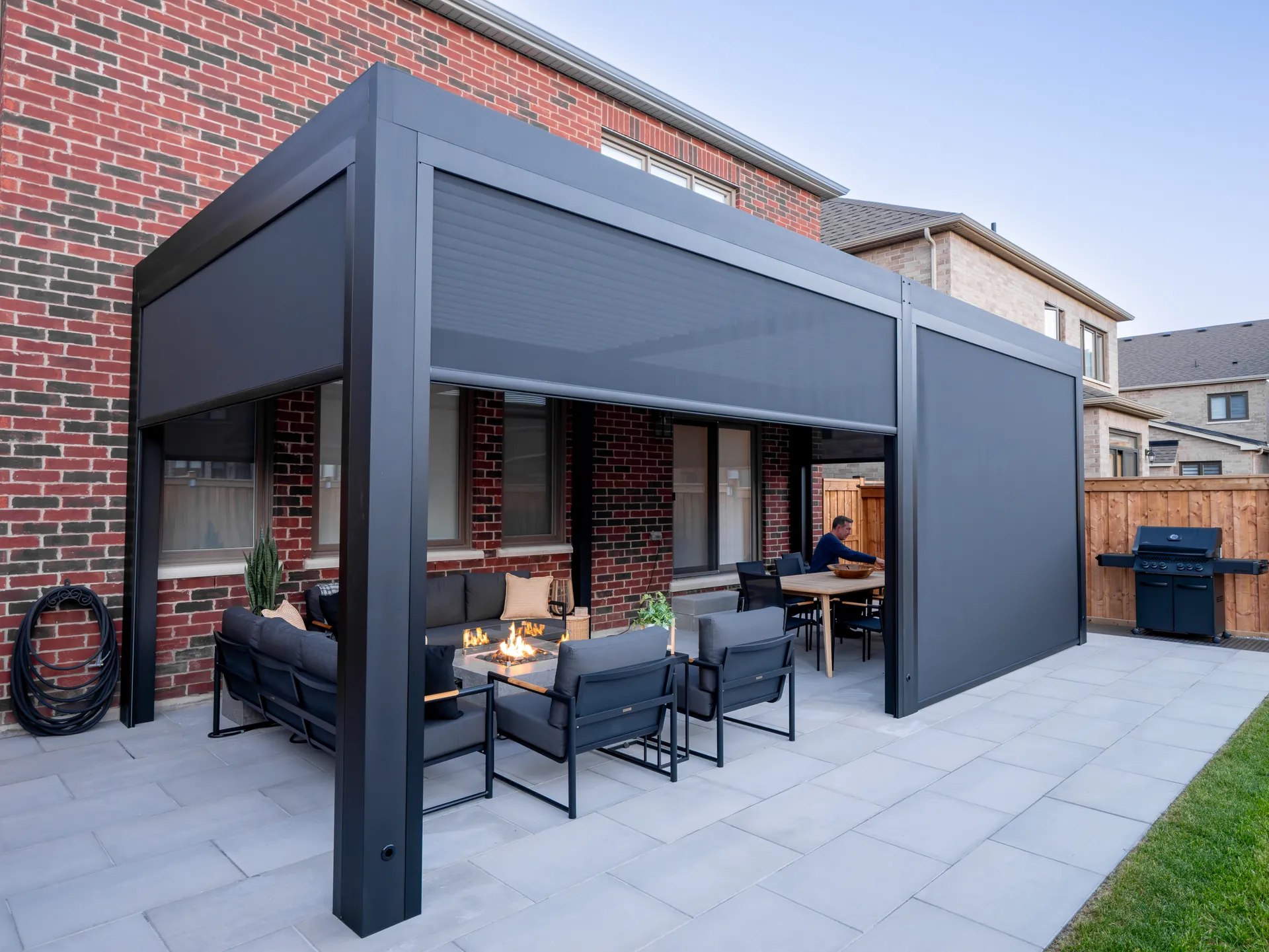
Privacy screens can help in a hot tub pergola or hospitality terrace setup, but the operating patterns could be entirely different in each case.
With a home-based hot tub, the screen will mostly need to stay down for privacy purposes. If the openings are easy to access and you only have one or two screens to manage, the manual method can suffice. Where views constantly change from private to open, a motorized option may be better.
For a restaurant, winery, or other hospitality venture, screens will need to move more often because of sun exposure, people occupying tables, wind, or service-related needs. There may also be enough openings for motorized outdoor screens with grouped controls to make sense. However, that does not mean that all commercial ventures have to use motorized options for their outdoor screens.
When dealing with any ZIP fabric screens, they must not be regarded as permanent outdoor walls or indoor room enclosures. Follow the manufacturer’s recommendations regarding weather use, ensure adequate clearance of other equipment, and consider permanent outdoor electrical connections.
Common Mistakes When Choosing Pergola ZIP Screens
Quick Answer: The three most critical mistakes include deciding between manual and power controls before knowing which sides need screening, installing powered screens without first planning for electrical service, and using fabric ZIP screens as permanent weather screens. All three mistakes begin with the same mistake of choosing something before knowing its purpose.
A screen system will be more effective when its use is well defined. While shade, privacy, insect screens, and light wind screening are interconnected but distinct functions, each may result in a screen system design suited to it. The mistakes often arise when customers select their controls before determining what they actually need. It may cause unnecessary expenses for powered controls when manual controls were all that was needed, or vice versa – selecting manual controls that turn out to be inefficient once several screens have been adjusted during the day. Better is to define exposure and privacy requirements first, then verify conditions for mounting and powering, and finally pick controls.
Choosing Controls Before Mapping Sun and Privacy
The temptation is to begin with “manual or motorized?”, but the real starting point should be, “Which openings require screening, and why?” The pergola does not have the same exposure to sunshine and privacy from all sides.
Plan for the openings based on:
- Low-angle sun exposure in the morning;
- Low-angle sun exposure in the afternoon;
- Neighboring lines of sight;
- Positioning of seating and dining;
- Hot tub and lounging privacy needs;
- Insect protection needs;
- Walking and access considerations.
As per building science advice, it is important to pay attention to orientation rather than to treat all facades alike. As stated in the Canadian government’s Natural Resources Canada guide on windows and exterior doors, the shading requirements will vary according to the amount of shading and orientation available. Although this advice targets buildings, the basic planning principle applies equally: sunlight varies by orientation.
After determining the sides that will require screening, next determine how frequently each screen will be opened and closed. At this point, the manual vs. motorized decision becomes clear.
Forgetting Power and Control Planning
Screen installations are most easily facilitated when electrical considerations precede finish selections and accessory configurations.
Prior to installation, find out:
- which screens need to be electrically powered;
- if electrical routing will be clean and safe;
- what service locations will be needed for powered devices;
- if there are independent or group operation screens;
- what relationship exists between control systems and powered louvers, lights or heaters; and
- if any special local electrical codes apply to the project.
For Ontario, the applicable electrical code as of May 1, 2025 is the 2024 OESC. The Electrical Safety Authority OESC website explains that the provincial electrical code is essentially the Canadian Electrical Code, Part I, with special provisions for Ontario.
The takeaway is not to design your own electrical routing, but to understand the powered screen requirements and involve an appropriate installer or electrician early on.
Treating ZIP Screens Like Solid Weather Walls
Although the ZIP screen is less open on the sides than a loosely installed roll-down blind, it remains a fabric screen system. As LOUSOL claims, the tracks provide better alignment and stability. It also says that screens serve as protection from direct sunlight, privacy protection, insects, and light or moderate wind. None of these features can justify the claim that the screen makes an exterior permanently closed wall.
Remember that:
- fabric screens are not structural walls;
- screens on the pergola do not make it a conditioned indoor space;
- weather elements can get inside the outdoor structure;
- wind-driven rain behaves differently from normal rain;
- rain and snow can interfere with the functioning of screens;
- LOUSOL advises against unfolding the screen while the profile is covered with ice or snow; use it only after the ice has been removed.
This distinction will help manage expectations. The ZIP screen allows creating more privacy and comfort outdoors while keeping the structure of the pergola as an outdoor one.
Expert Tips for Planning Pergola ZIP Screens
Quick Answer: Design screen installations based on each side’s exposure and use, plan control areas before any wiring, and ensure the cassette, tracks, screens, and motors are all easily accessible. The three choices will avoid over-specification of screens when there is no need and under-specification of controls where daily adjustment becomes difficult.
The most valuable screen advice tends to be operational in nature. Rather than simply deciding on the basis of aesthetics whether one or another material or motor will suit the needs best, think about what will happen in the morning, in the afternoon, at dinner time, and whenever the room is used for entertaining. A westward-facing screen will require more adjustment, while a privacy screen facing the neighbor might stay closed longer. The access screen is likely to require being open more often than both of the others.
Prioritize the Sides That Actually Need Screening
Four sides do not necessarily mean the same screen on all four sides. It’s a good idea to start with exposure mapping and determine the function of each screen.
For instance:
- East side: either morning glare or privacy
- West side: low-angle afternoon sun
- Neighbor’s side: privacy
- Garden side: probably best left unscreened for visibility purposes
- Dining side: insect repellence becomes more important in the evenings
- Access side: constant traffic may make a permanently closed screen impractical
This strategy follows the general energy-saving guidelines of Canada. According to Natural Resources Canada, it recommends installing solar screens, solar films, awnings, and trees to minimize solar heat gains in buildings with east- and west-facing windows in its guide on how to build an energy-efficient building. This doesn’t give any specific performance data for a LOUSOL screen, but it explains why the sun’s direction matters.
Expert tip: do not install a screen on every side as the default option. Figure out the purpose of each screen first.
Plan Motorized Screen Control Zones in Advance
The motorized system would work better if the control system were designed around the spatial needs. Determine how the screens are going to be moved before the wiring is completed.
Questions to ask:
- Does it make sense to control each screen individually?
- Are there some screens which would always move in unison?
- Is there a use for an “open all” or “close all” command?
- Is remote control sufficient?
- Are mobile app and Google Assistant controls needed?
- Are screen controls necessary in addition to louver and light controls?
- Does it make sense to create an easier protocol for employees, families, and guests?
According to LOUSOL, any motorized screen may be programmed separately, and screens may be controlled independently and collectively. In a multi-sided pergola, this feature would be especially useful as it makes it possible to have one screen lowered to provide privacy while the other is adjusted according to the changing sunlight.
The best control system isn’t the most automated one, but the one that minimizes unnecessary actions.
Design for Cleaning, Winter Use, and Service
The screens must be easily accessed once the pergola has been outfitted and landscaped. Provide sufficient access to clean the fabric, wipe the tracks and any exposed surfaces, and access the cassette or any other powered components for servicing.
The care instructions provided by LOUSOL are clear: wipe down the screens using a soft, wet sponge or cloth with a nonabrasive, water-based household cleaner, and then let the screen dry out. For motorized screens, disconnect the power first before cleaning. When there is frost and snowfall, avoid unfolding the screen when the profile is frosted over or snowed on.
Planning during winter is crucial in Canada since snow also reflects ultraviolet rays. The Government of Canada’s Environment and Climate Change Canada points out that new, fresh snow can reflect over 80% of UV light, according to their UV Index and sun safety information. This does not mean that the ZIP screen must be deployed on snowy days; it illustrates why outdoor shading is not a concern just for the summer months.
Effective planning thus includes proper access to the screen as well as knowing when it is not advisable to use the screen.
Key ZIP Screen Numbers and Canadian Shading Data
Quick Answer: Decision-Useful Information: Screen-size dimensions and warranties from LOUSOL and third-party research on the importance of adjustable shading systems. LOUSOL’s current published dimensions are 4–20 ft wide by 4–14 ft high and include a 5-year warranty on the ZIP frame and fabric. There is also a 2-year warranty on the motorization and electronics.
The information must be useful enough to actually answer a buyer’s question, as opposed to merely providing some figures. Dimensions are needed to judge if an opening is within the published range for LOUSOL. Warranty information will indicate how warranties differ across screen parts and other equipment. Canadian and building science sources on the effects of exterior shading and sun are independent of LOUSOL and provide additional information, but not actual test data that would justify claims. Thus, the information provided below is separated into three groups based on their legitimacy to support a claim.
| Statistic or Measurement | Published Source | What It Means for the Reader | Important Limitation |
|---|---|---|---|
| Screen width: ~4–20 ft | LOUSOL | Broad custom width range is published | Final opening still requires project measurement |
| Screen height: ~4–14 ft | LOUSOL | Broad custom height range is published | Fit depends on actual structure |
| ZIP frame/fabric warranty: 5 years | LOUSOL warranty | Coverage period for these components | Warranty terms and exclusions still apply |
| Somfy motorization/electronics: 2 years | LOUSOL warranty | Powered components have separate coverage | Does not define motor lifespan |
| Shade is recommended when UV is high | ECCC/Health Canada | Shade is part of sun-safety planning | Does not quantify protection from one screen product |
| Exterior adjustable shading can reduce solar gains | NRCan/NRC research | Exterior shade can affect thermal/solar conditions | Window studies are not pergola-screen performance tests |
LOUSOL Dimensions and Warranty Figures
LOUSOL offers custom ZIP screens currently in the range of about 4 to 20 feet wide and 4 to 14 feet high. Exact sizes should be based on the actual pergola opening.
The current warranty terms are:
- ZIP screen frame and fabric: 5 years;
- Somfy-driven motorization: 2 years;
- Motor, power supply, receiver, and control electronics: 2 years.
These figures distinguish the warranty for the screen itself from the powered components; they do not establish the service life expectancy. LOUSOL also states that the slight waviness of fabric near the rails or horizontal traces after rolling does not necessarily mean defects. Please refer to the current ZIP screen specifications and warranty information.
What Canadian Exterior-Shading Research Shows
The independent studies justify the use of adjustable exterior shading, but they should not be used as proof of LOUSOL screens’ efficiency.
The Natural Resources Canada study of summer shading effectiveness at the Canadian Center for Housing Technology talks about movable exterior shading as an instrument to control excessive solar heat gains. The second study by the National Research Council evaluates exterior rollshutters and interior blinds at windows. The Lawrence Berkeley National Laboratory states that outdoor shutters, roller shutters, and awnings are used as instruments to control solar heat gains in the review of residential window attachments.
These studies justify the importance of adjustable exterior shading as such, not any particular thermal or energy benefit of LOUSOL ZIP screens.
How to Use the Numbers Without Overclaiming
Treat four kinds of evidence differently. Product specifications will provide LOUSOL’s dimensions, controls, and build. Warranty details will cover the coverage period and not the lifespan of components. Independent research on shading will cover principles behind solar control. Specific performance claims will require specific testing.
Health Canada advises seeking shade as one way of protecting against extreme heat, but this advice does not set out a reduction in temperature due to a specific pergola screen. Lacking documentation of LOUSOL testing, do not give a percentage cooling reduction, energy savings, or wind speed rating or temperature reduction to the ZIP screen.
LOUSOL Case Study: Manual vs Motorized Screens
Quick Answer: LOUSOL’s project portfolio consists of real pergolas featuring either a manual or motorized ZIP screen. For instance, 10×12 Etobicoke KIT features a manual louver roof and a manual ZIP screen, whereas a different 12×12 Etobicoke project includes a manual louver roof together with a motorized ZIP screen. It follows that one may choose to control the screen independently of the roof.
Projects which have been released become particularly valuable when they reveal what has been done rather than when they are used as means for inferring customer motivations. One example in the LOUSOL portfolio includes two projects in Etobicoke: one is equipped with a manual roof and a manual ZIP screen, whereas the other is equipped with a manual roof and a motorized ZIP screen. The main benefit of these projects is that they both reveal how control was used in the projects, since they explicitly state it. It does not reveal which option is more effective.
| Project | Location | Pergola Size | Louver Operation | ZIP Screen Operation | Other Published Features | What It Demonstrates |
|---|---|---|---|---|---|---|
| Screen Pergola KIT | Etobicoke, ON | 10×12 ft | Manual | Manual | Umbra Grey frame, Pure White louvers, white ZIP screen, warm LED | Manual roof and screen can form a simple KIT configuration |
| Louvered Pergola | Etobicoke, ON | 12×12 ft | Manual | Motorized | Umbra Grey frame, Pure White louvers, white ZIP screen, warm LED | Screen motorization can be selected independently of roof operation |
Manual Screen Project: Etobicoke 10×12 KIT
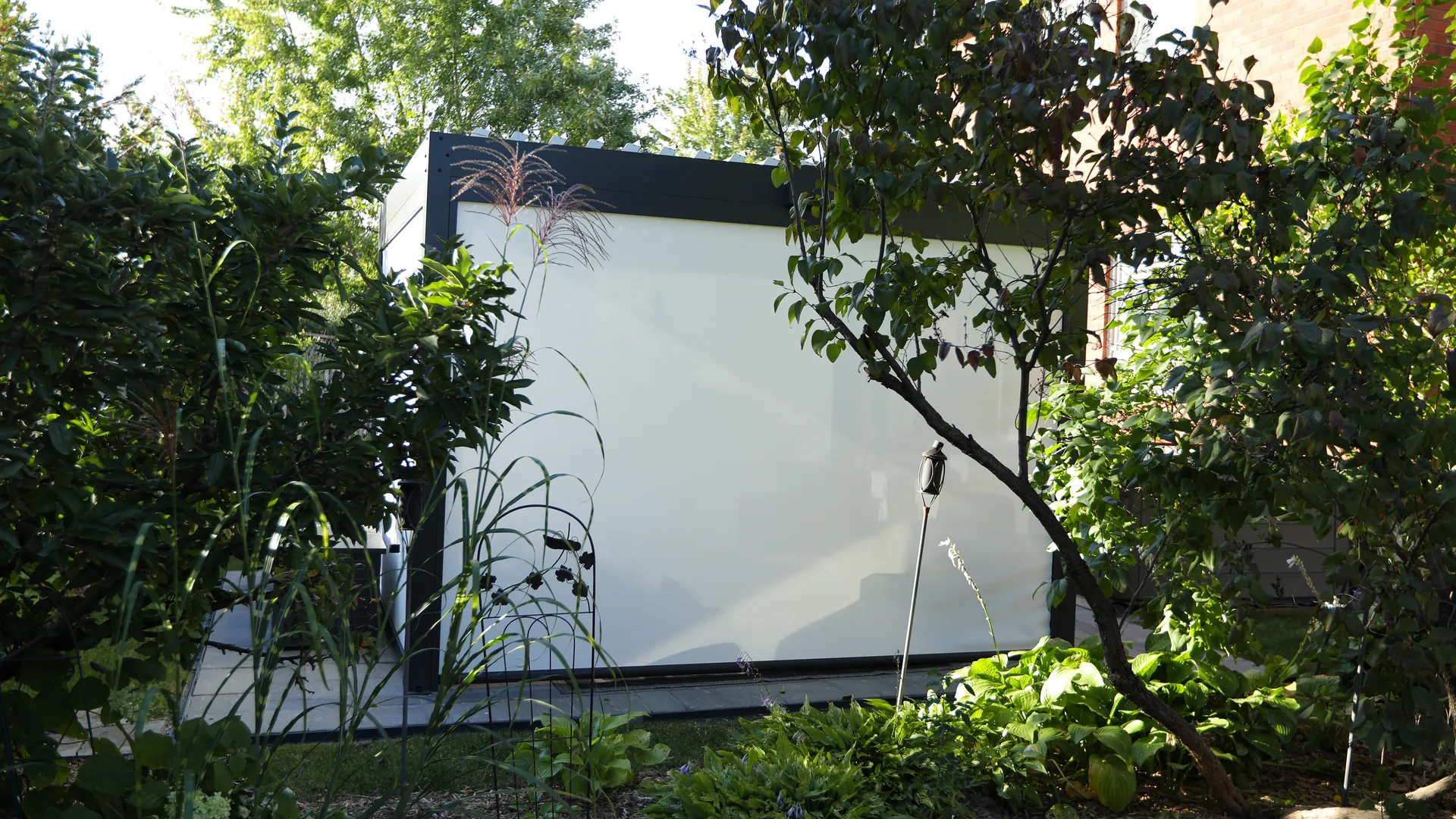
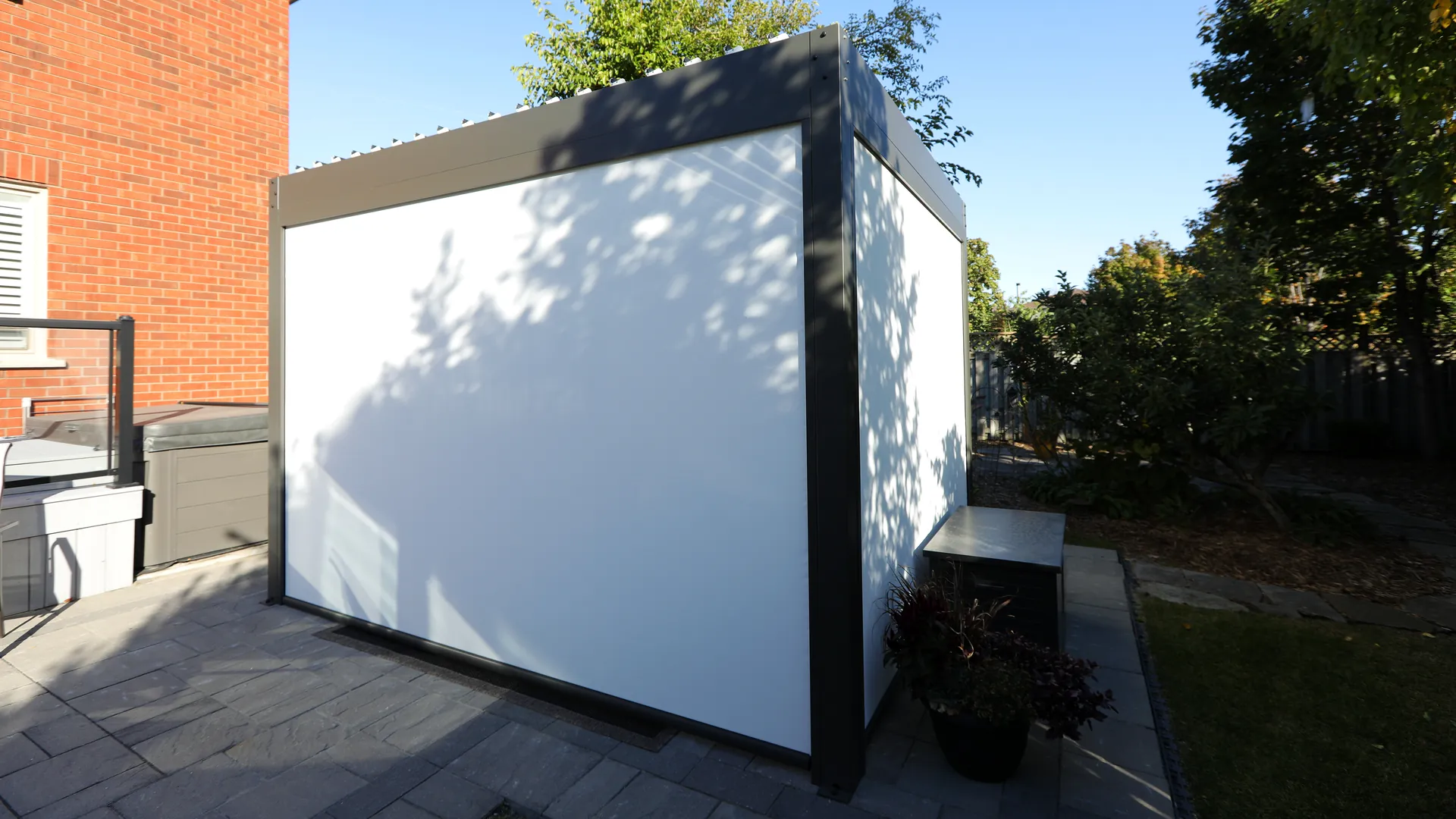
LOUSOL’s published Screen Pergola KIT 10×12 Project located in Etobicoke includes:
- size: 10×12 ft;
- frame: Umbra Grey;
- louvers: Pure White;
- ZIP screen: white;
- LED lights: warm;
- roof: manual;
- ZIP screen: manual.
The information does not explain why manual mode was chosen, and no efficiency measurements are provided, so the data cannot be assumed. The only thing that can be guaranteed is a practical implementation of LOUSOL KIT with manual roof and manual ZIP-screen operation.
Motorized Screen Project: Etobicoke 12×12
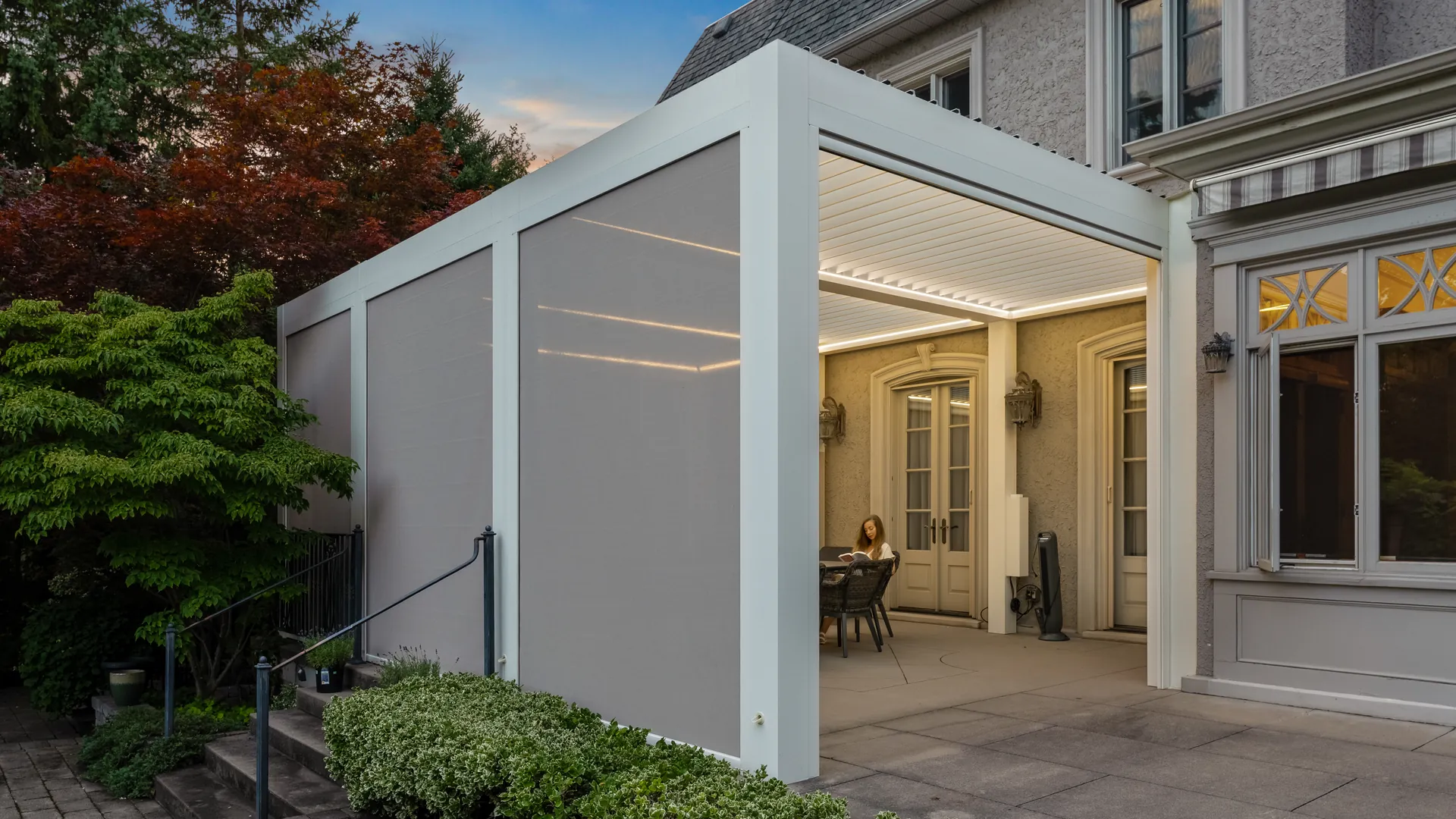
The additional 12×12 Etobicoke project features an Umbra Grey frame, Pure White louvers, a white ZIP screen, warm LED lighting, a louver roof with manual operation, and a motorized ZIP screen.
This design is a strong example of a key idea: you can choose screen motorization independently of roof motorization. Since the project page doesn’t explain the customer’s decision to use motorization, the examples of reasons can be general.
What These Two Projects Can Actually Tell Us
Combining these two Etobicoke case studies yields three observations: LOUSOL uses both manual and motorized screens; screen operation need not align with the louvers; and pergola size alone does not indicate the appropriate control.
Instead of using guidelines such as “for small pergolas use manual control” and “for large pergolas use motorized controls,” base the choice on:
usage patterns, number of screens, preferred method of control, power source, and fit.
The project examples show various combinations, but the final design must match the opening and how you use the outdoor space.
Conclusion: Choosing the Right ZIP Screen Setup
Manual and motorized pergola screens are two solutions to the basic side-screen issue in pergolas. If simplicity matters more than powered convenience, and you open the screen infrequently, a manual solution is the better choice. Frequent opening, multiple openings, remote or app control, and other similar issues may favor the use of motorized outdoor screens.
When ordering, determine the size of openings, the number of screened sides, how often you need to adjust them, available power sources, control locations, whether you have a new or existing structure, how you’ll clean them, winter-use requirements, and warranty coverage. This information is more important than just choosing automation because it is possible.
For a standard configuration, you may want to consider LOUSOL’s 10×12 pergola KIT. Non-standard sizes and the integration of screens into the control and operation process call for custom aluminum pergolas. You can also review LOUSOL’s current ZIP screen models and talk with the company about your project specifics.
The best ZIP screen arrangement simplifies pergola use without unnecessary controls, wiring, or complications.
FAQs About Manual and Motorized Pergola ZIP Screens
Are pergola ZIP screens completely opaque when lowered?
No, they aren’t. In fact, the fabric used in the current version of the screen has 5% transparency and therefore does not block all light and visibility. With such fabric, you have a side opening that is more protected than usual.
What colors are available for custom pergola ZIP screens?
LOUSOL provides customers with custom pergola ZIP screens in 5 colors, which are Graphite Black, Natural, Sea Lion, Gray Pepper, and Frost White. You can choose a color that matches your pergola while using the same ZIP screen operating principle.
Does the 10×12 pergola KIT offer the same screen colors as custom systems?
No, it doesn’t. LOUSOL currently provides white manual ZIP screens for the standard pergola 10×12 KIT, but not other colors. If the color of the screen is essential for your project, then make sure you compare the KIT and custom options.
What does the top cassette do when a ZIP screen is raised?
When the screen is raised, its material is rolled into the aluminum top cassette, as opposed to being left exposed outside. This keeps the fabric contained within the cassette and protects it from dust, moisture, and excessive exposure.
Can ZIP screens be used on covered outdoor spaces other than pergolas?
Yes, according to LOUSOL, their custom ZIP screens can be applied not only to pergolas but also to louvered pergolas, patios, or other covered outdoor areas. However, the opening will need to have proper dimensions and conditions for the installation of the cassette and side tracks.
When are custom ZIP screens measured for a pergola?
For the custom ZIP screens for pergolas, the measurements of openings take place after the pergola structure is put in place. This is how the manufacturer describes the process of laser measuring done before sending the dimensions to the factory.
Are custom ZIP screens made only in fixed standard sizes?
No. Custom ZIP screens are designed to match the measurements of the actual opening within the product’s available size range. That is why the cassette, the side tracks, and the fabric can be adjusted to the actual pergola bay without being limited by the same standard screen size.
Is slight bowing of the bottom weight bar always a defect?
No. Some bowing of the bottom weight bar may occur with wider ZIP-screen units and can cause fabric waviness near the rails. According to the manufacturer’s guidelines, this behavior is sometimes considered normal.
Are horizontal marks or slight waviness on ZIP-screen fabric normal?
Yes, they can be. Horizontal marks can form as the fabric moves around the roller shaft, while a slight wavy pattern may form along the side rails depending on the fabric’s rigidity. However, this is not an indicator of damage by itself if the screen works properly.
Should a ZIP screen be rolled up immediately after cleaning?
Not necessarily. Once the screen has been cleaned with a soft, damp cloth or sponge and an appropriate non-abrasive cleaner, it needs to remain open to dry completely before being rolled back up into the cassette.
Checkout more
helpful articles

Pergola Installation vs DIY: Which Saves You Money?
When DIY pergola installation genuinely saves money, when a professional...

Restaurant Patio Covers That Increase Revenue
A practical framework to estimate how much revenue a covered...


Best DIY Aluminum Pergola Kit Features
The features that make a DIY aluminum pergola kit easy...
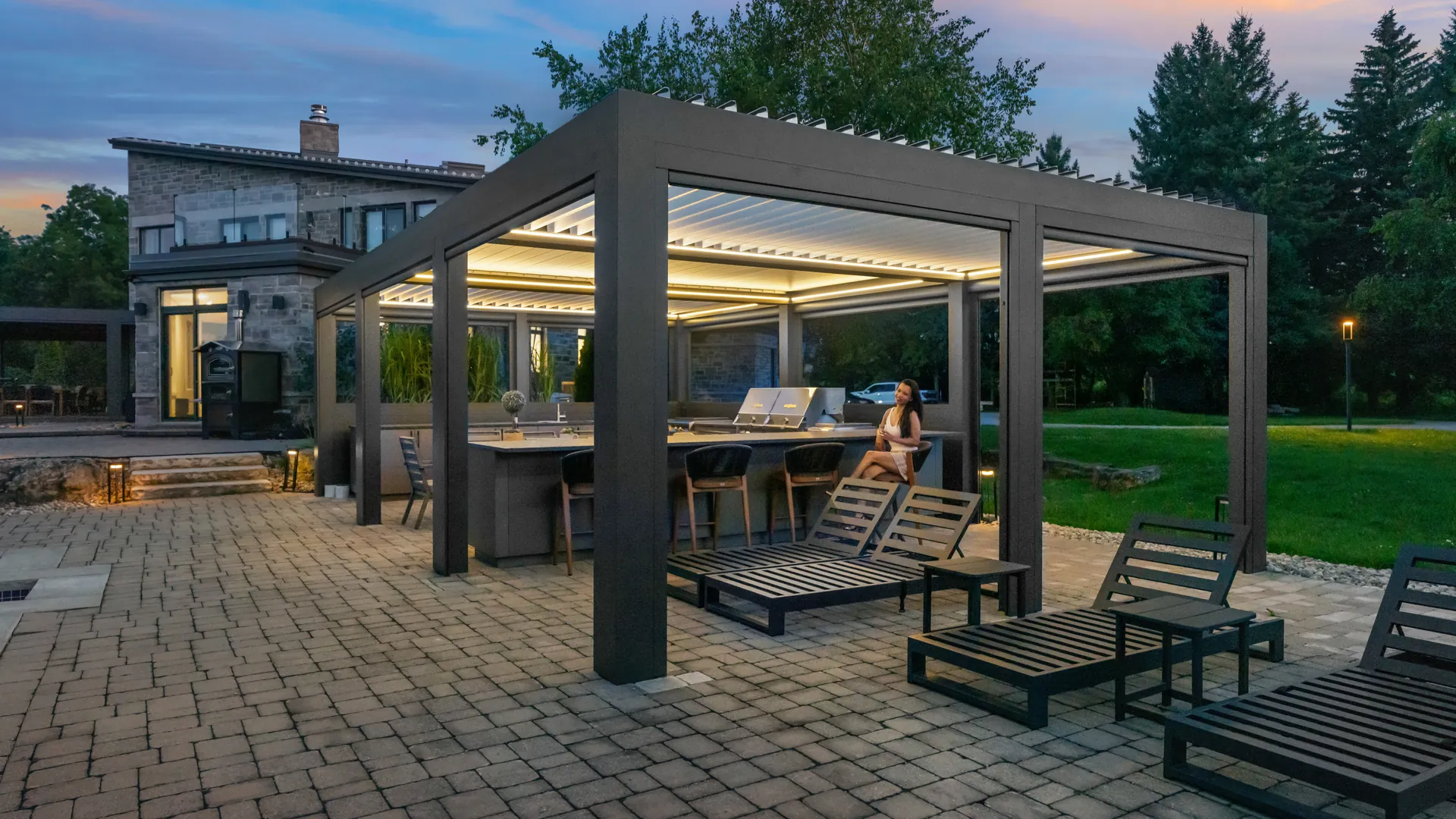
How to Plan a Custom-Size Aluminum Pergola
How to plan a custom-size aluminum pergola: measurements, footprint, post...


