


How to Choose the Right ZIP Screens for Your Pergola
Selecting ZIP screens for your pergola does not only involve choosing a color for your screens or considering a motor option. Your choice depends on how you’ll use the space, which sides are exposed to sun and wind, how much privacy you need, how much outdoor view you want to preserve, the size of the openings, and how often the screens will move.
LOUSOL considers ZIP screens as a full part of the pergola package. LOUSOL custom-made pergola ZIP screens use Soltis® Veozip fabric with 5% transparency and can include a manual hand-crank system or Somfy motor control. Motorized screens can be operated remotely via an application or Google Assistant. Screens can be controlled individually or in one group.
Remember, none of these factors alone is always the best choice. A screen that gives you privacy will affect your view in some way. A motorized screen makes your life easier but implies additional power planning. Fabric that works well during the day may give you a totally different impression once the pergola is lit up.
This article helps you understand how to make this decision.
Quick Answer: When selecting pergola ZIP screens, consider these five factors: privacy, visibility from outside, exposure to sunlight and glare, opening size, and how often you adjust the screens. Screens controlled manually would work best for simple and infrequent adjustments that don’t require electricity. Motorized screens are ideal for frequent screen adjustments and multiple screens. Fabric opacity has an impact on both privacy and visibility.
[Show/Hide]
TL;DR
- Identify the problem that the screens will solve for you – privacy, sun protection, glare control, bug control, side lighting, or any combination of these.
- LOUSOL offers the Soltis® Veozip fabric with 5% visibility that is made to maintain the view out while protecting against glare and excessive sunlight.
- Treat privacy as relative rather than absolute, and consider light direction, especially at nighttime.
- Manual screens utilize a hand crank and do not require power.
- Motorized screens are powered by Somfy and can be controlled via remote, mobile app, or Google Assistant.
- Clarify your needs for opening size, installation options, and power requirements before placing an order.
- If convenience is what you are looking for, go for motorized controls; otherwise, go for manual.
A pergola ZIP screen not only transforms the look of the covered area, but also affects side exposure, visibility of the surrounding landscape, flexibility with low-angle sun and weather changes, and daytime usability. Well-planned outdoor ZIP screens should therefore be selected around the actual conditions of the space rather than appearance alone.
Therefore, the most practical approach is not “which screen is better?” but “what screen configuration is best for this pergola?”
For instance, when choosing a pergola with high levels of privacy, nighttime visibility might be more important than automation features. When choosing a screen for a west-facing outdoor dining room, low-angle sunlight in the afternoon might become a problem to be solved. In the case of a large multi-screen commercial pergola, control convenience might become more important, since multiple screens have to move many times throughout the day.
It must also be kept in mind that the Canadian climate varies greatly depending on location and season. For instance, Environment and Climate Change Canada has published Canadian Climate Normals 1991-2020 for various locations across the country, which is a good example of how to consider sun, wind, and seasonal factors for the specific project location rather than the national average.
The following sections will show how all of these variables can be converted into the selection process.
Start With Your Privacy, Exposure and Use Priorities
Quick Answer: Firstly, determine what needs to be altered on the screen. Issues such as privacy, glare, insects, side wind, and retention of view differ in priority. Before choosing colors and materials, determine when you’ll use the pergola, which sides will be exposed, and how much you want to retain the view.
Just move around your pergola as you would normally do. Look towards your neighbors, streets, gardens, and even the low-angle sunlight. In case your pergola is yet to be designed, plan these aspects before settling on the number of screens that you need.
| Priority | What to Evaluate | Why It Matters | What to Verify Before Ordering |
|---|---|---|---|
| Privacy | Sightlines, lighting, transparency | Privacy changes with distance and lighting | Day and night visibility |
| Sun and glare | Sun direction and time of day | Low-angle sun often enters from the side | Which opening receives direct sun |
| Insects | Gaps and number of open sides | Physical barriers work best with fewer gaps | Track fit and open access points |
| Side exposure | Direction of wind/rain | Screens can reduce exposure | Product and project limitations |
| View retention | Desired outward visibility | Enclosure changes the visual connection | Fabric appearance from inside |
| Convenience | Adjustment frequency | Frequent use can favor motorization | Power and control method |
Define What You Want the Screen to Change
While many consumers start with pergola privacy screens, privacy might only be one piece of the puzzle. Prioritize your needs:
- reduce exposure to neighbors or passers-by;
- eliminate sunlight and glare from the side;
- deter insects from entering;
- provide greater protection in the dining/lounge area;
- maintain as much visibility of the surroundings as possible;
- ease adjustments throughout the day.
Environment and Climate Change Canada reports that the UV Index in Canada can be 3 or higher between 11 a.m. and 3 p.m. from April through September. Health Canada also emphasizes the importance of shade along with wearing clothes, using sunglasses, and applying sunscreen, where applicable.
If you need the privacy the most, consider transparency and light first. If you wish to maintain visibility the most, consider visibility outwards first.
Identify Which Pergola Sides Need Screening
There is no automatic requirement to have screens on all sides. Inspect each opening with regard to:
- sightlines of neighbors and street;
- exposure to morning or afternoon sun;
- wind direction;
- orientation for outdoor eating and/or hot tub;
- possible insect entry points;
- views to maintain.
The western side might require screening against the afternoon glare, but the garden side would stay open. Selective outdoor ZIP screens allow you to address the real exposure issue without closing the pergola from all sides.
It is also useful to consider the space several times. A side that does not seem problematic at 10 am can become a major source of glare at 5 pm, while a neighbor sightline can be an important issue only when the pergola lights are on. If you already have a patio, consider the situation in its normal operation. In case of building a pergola, take into account house orientation, nearby structures, and furniture arrangement.
Screening can also help prevent insects’ entry into the area by providing a physical barrier. According to the Public Health Agency of Canada, well-screened areas and repair of gaps are part of an insect bite prevention strategy. The pergola is an open-air structure, and screening effectiveness will depend on how complete the opening screening is.
Measure the Opening and Check Structural Compatibility
Prior to ordering:
- Measure the clear dimensions of each opening.
- Check mounting surfaces for the side tracks and upper cassette.
- Check if the screen will be used in a new pergola or retrofitting.
- If the screen will be motorized, check the power access.
- Check if screens will operate individually or as a group.
- Check the final configuration prior to manufacturing.
According to LOUSOL, the range of ZIP screens is approximately 4-20 ft in width and 4-14 ft in height. It helps in planning but does not guarantee that all openings will fit.
For LOUSOL installations, the company says openings are laser-measured after pergola installation, before final screen manufacture. When working on a new installation, consider the screens along with the custom pergola.
Compare Fabric, Transparency and Privacy Trade-Offs
Quick Answer: Choose fabric based on privacy, view retention, and sun exposure. LOUSOL provides Soltis® Veozip in 5% transparency. This does not mean the privacy level is set in stone, since factors like light levels, indoor lighting, viewing angle, and viewing distance will affect how much you can see through the screen.
Fabric affects both the appearance and function of the outdoor space. The aim is not to maximize one characteristic at all costs, but to find the balance that fits how the pergola is used.
| Consideration | Privacy Effect | View Effect | Best-Fit Priority | Limitation |
|---|---|---|---|---|
| 5% transparency | Adds visual separation | Retains outward visibility | Balanced privacy and view | Not opaque |
| Brighter exterior | Can improve daytime privacy | View can remain usable | Daytime patios | Changes as lighting changes |
| Brighter interior at night | Can reduce privacy from outside | Outward view remains | Evening use | Silhouettes may show |
| Color choice | Changes visual contrast | Affects appearance | Design coordination | Do not assume unverified performance differences |
What 5% Transparency Means for a Pergola Screen
LOUSOL mentions that Soltis® Veozip has 5% transparency. In reality:
- the screen is not an opaque wall;
- there is some visibility to the outside;
- visual exposure and glare can be minimized;
- its appearance depends on light direction and contrast.
Furthermore, LOUSOL cites the fabric manufacturer’s claim that Soltis® Veozip screens can block 96% of UV rays. According to Serge Ferrari Group, Soltis Veozip is an outdoor screen fabric for solar protection, glare reduction, and controlled transparency.
This statement describes the fabric’s performance, not a promise of complete protection from UV radiation. UV radiation intensity depends on many factors, such as time of day, season, and weather conditions.
Daytime Privacy and Nighttime Privacy Are Different
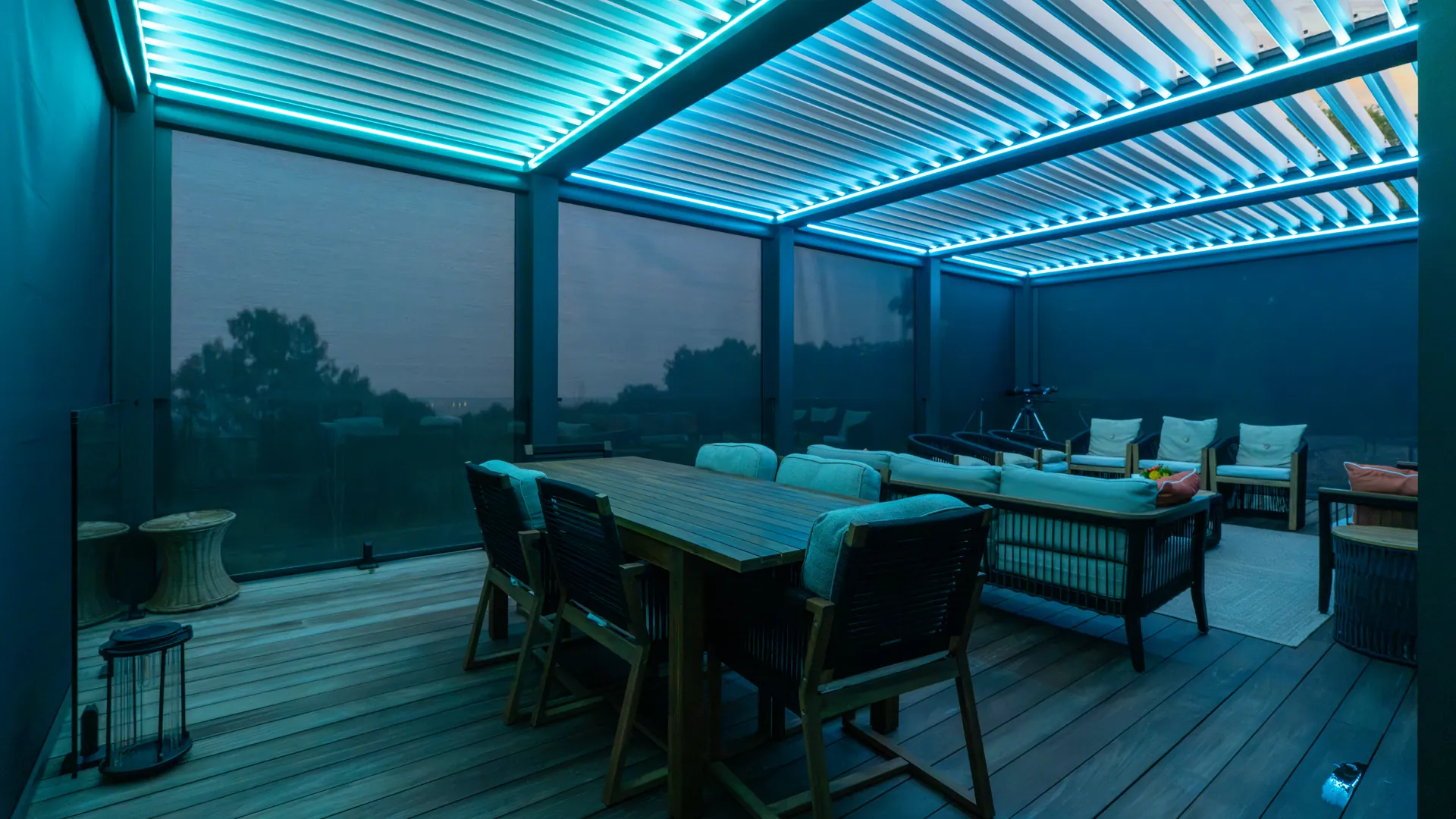
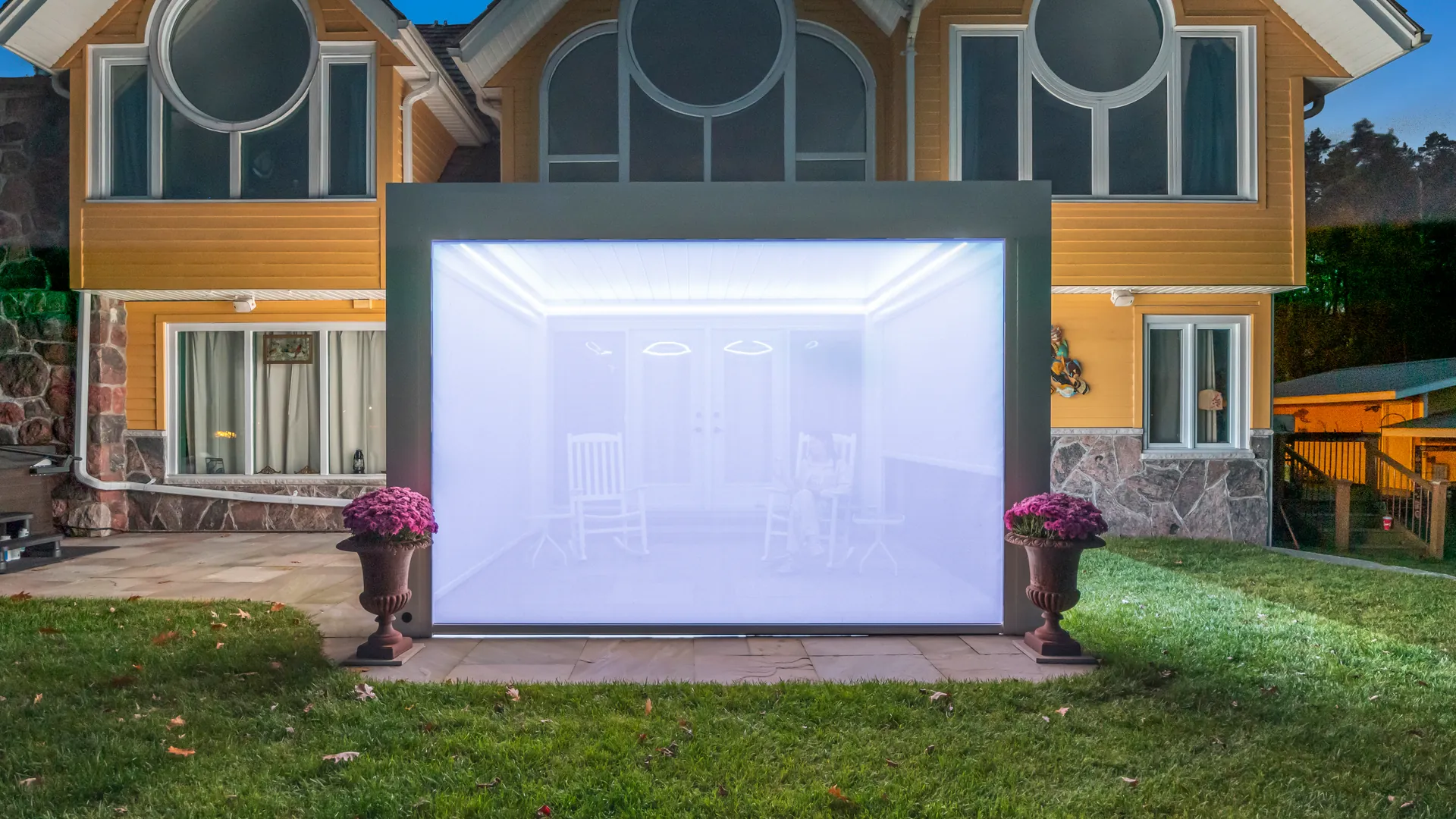
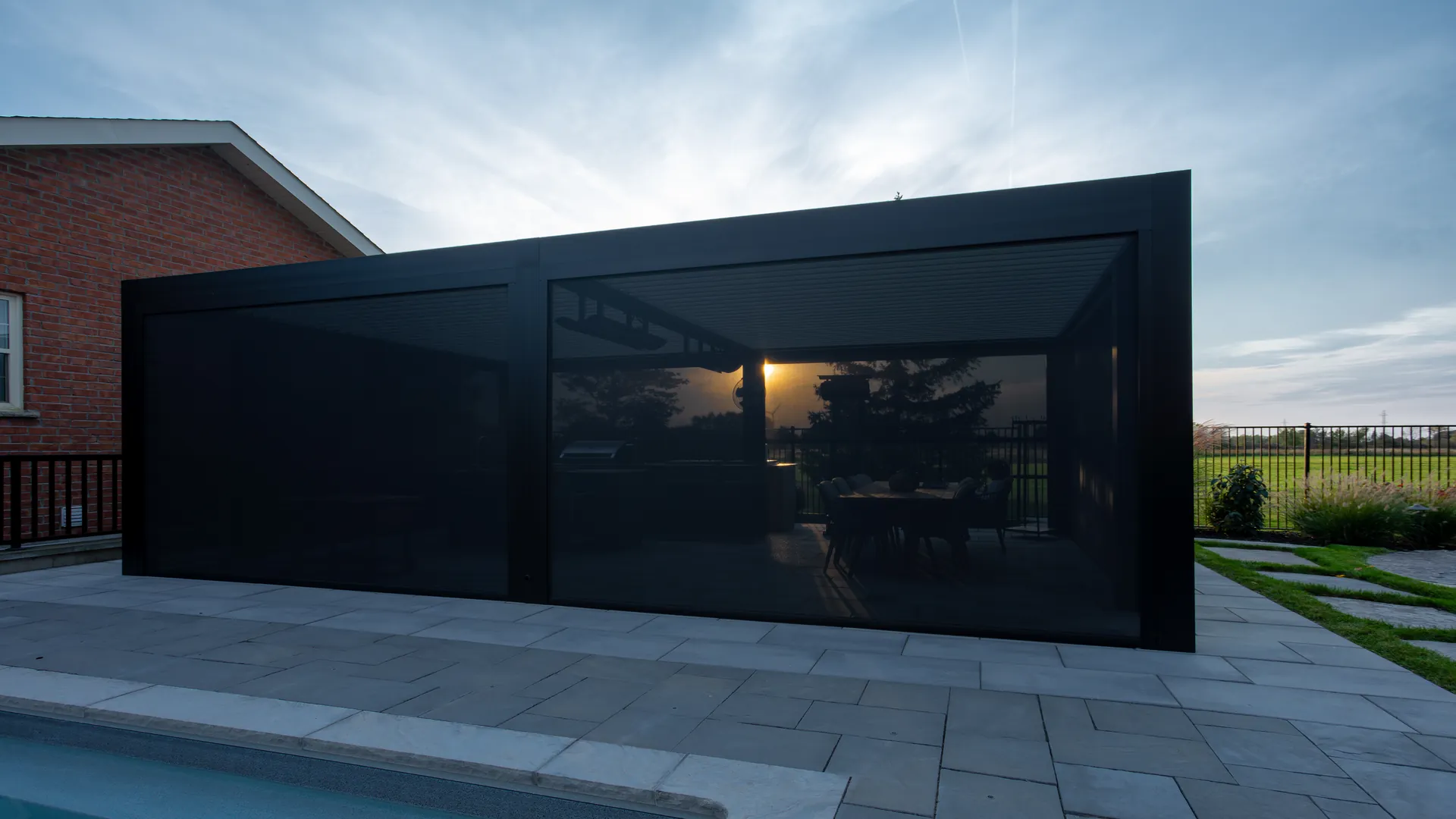
In the daytime, the bright exterior and shade of the pergola will reduce visibility into the space. At night, brightly lit pergola screens will switch the roles of inside and outside, making silhouettes more visible.
When selecting the screen for its primary purpose of providing privacy, consider the following criteria:
- daytime or evening use;
- lighting within the pergola;
- closest line of sight from the neighbor or walkway;
- viewing distance and viewing angle;
- privacy needs: preference or necessity.
When comparing pergola privacy screens for evening use, evaluate the fabric under real lighting conditions and compare it with a more solid alternative like an aluminum pergola privacy wall where stronger separation is required.
To assess the nighttime privacy of the screen, turn the pergola lighting on.
How Screen Color Can Affect the Visual Experience
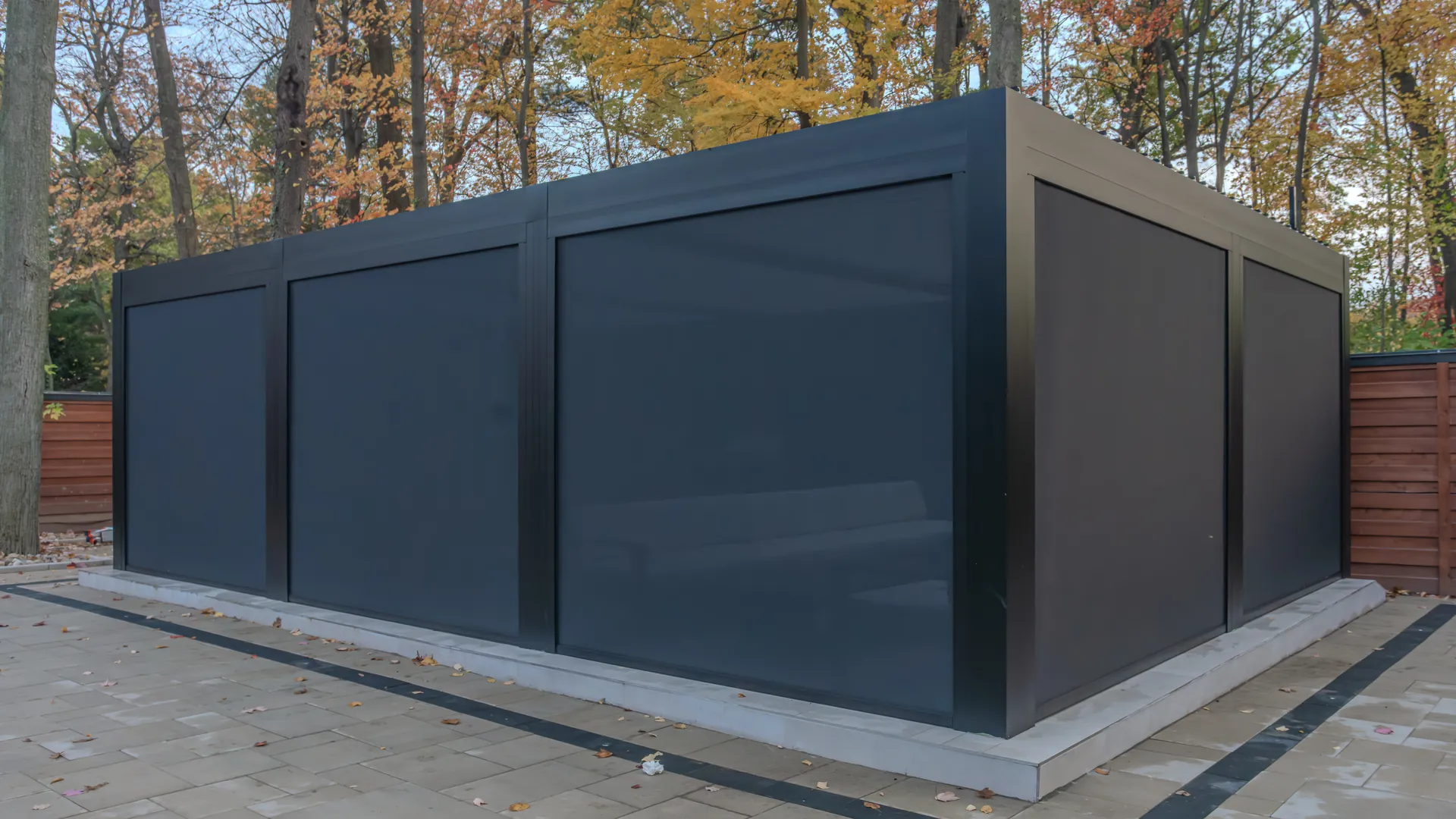
LOUSOL includes Graphite Black, Natural, Sea Lion, Gray Pepper, and Frost White.
Select a color based on its comparison to the frame, louvers, exterior colors, and landscape. Do not assume that one color offers any particular privacy, heat protection, or UV benefits unless technical documentation backs that up.
The LOUSOL gallery and recent projects offer good examples of how colors work as part of the overall installation, not just as color samples.
Comparing the colors involves viewing the screen both inside and out. From inside, the key factor will be whether the fabric maintains the connection of the outside space to the rest of the yard. From the outside, you can see how the screen interacts with the frame and the house. This dual approach works better than simply selecting from a small swatch, since the screen lowers to become a large wall in the outdoor space.
Balance Shade, View and Privacy Instead of Maximizing One
Apply a straightforward priority system:
- Privacy first: Start with visual privacy and test nighttime screening.
- Viewing first: Maintain your viewing capabilities and screen only those sides that require screening.
- Comfort first: Start with glare, sun from the side, bugs, and frequency of screening use.
Environment and Climate Change Canada offers the UV index prediction, a good reference point in considering sun exposure seasonally.
Choose Between Manual and Motorized ZIP Screens
Quick Answer: Choose manual pergola screens when you anticipate adjustments and want basic hand-crank operation without electricity. Choose motorized pergola screens if you need frequent screen movement, multiple openings to control, or remote/mobile app control. LOUSOL Motorized ZIP screens are powered by Somfy and controlled remotely via mobile app or Google Assistant.
Control method should be based on the use pattern. Motorization does not mean “superiority” by itself, while manual control is not “simple” at all. The best control method would be that which matches adjustment frequency, number of panels, availability of electricity, and desired degree of automation.
It could be helpful to consider an ordinary week rather than a day with the most favorable weather conditions. Calculate the number of adjustment operations per week and who will do them. Adjusting one screen from time to time for privacy purposes results in quite another set of requirements than adjusting several sides during breakfast, lunchtime, and in the evening for entertaining purposes.
| Factor | Manual ZIP Screen | Motorized ZIP Screen |
|---|---|---|
| Operation | Hand crank | Somfy-powered motor |
| Electrical power | Not required | Required |
| Best fit | Occasional adjustment | Frequent adjustment |
| Multiple screens | Operated one at a time | Can be programmed individually or together |
| Remote control | No | Yes |
| Mobile app | No | Yes |
| Google Assistant | No | Yes, per LOUSOL product information |
| Key pre-order check | Accessibility of crank | Power, wiring and control plan |
| LOUSOL warranty context | ZIP screen frame/fabric: 5 years | Motorization/electronics: 2 years; frame/fabric: 5 years |
When Manual Pergola Screens Make More Sense
Manual screen control uses a crank that does not need any source of power. Manual screens are therefore a better choice when you won’t need to move the screen often, or when electric integration would complicate the process without much advantage.
Manual control should be considered where:
- there is only one or a few screens;
- the screen will be adjusted infrequently;
- it is easy to reach the crank point;
- electric power supply is not available;
- there is no need for smart home controls;
- simple manual control is preferred.
Frequency is the most important issue here. Where the lowering of the screen is done once in the afternoon and raising in the evening, manual control using a crank might work very well. But when the process needs to respond to sun, wind, and customers’ activities at different opening points several times, it can become cumbersome.
It is not wise to assume that manual control is cheaper or more reliable than automatic operation throughout the life cycle of the screen since it all depends on installation and maintenance.
When Motorized Pergola Screens Are the Better Fit
Motorized screens are most beneficial in those situations where the adjustment of screens becomes a regular part of the daily process rather than a sporadic activity.
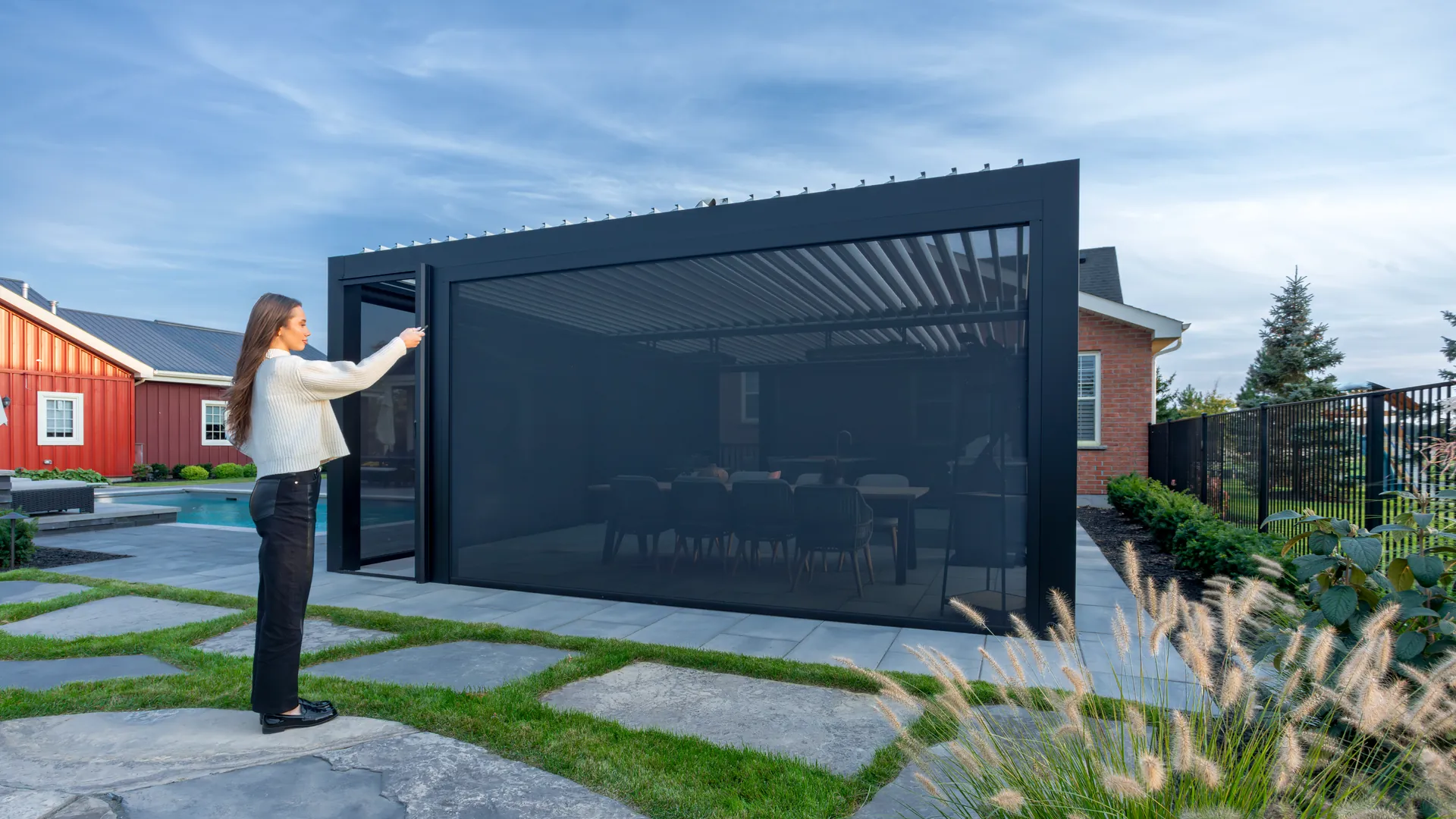
The motorized ZIP screens by LOUSOL are powered by Somfy and are controllable by means of:
- remote control;
- mobile application;
- Google Assistant;
- programming of individual screens;
- grouping control of multiple screens.
This is especially true in the case of large pergolas, multi-sided structures and hospitality areas where there will be changes throughout the day. It is no longer necessary to go to each screen separately and operate them manually by the crank. Screens can be adjusted either individually or collectively by using the chosen control interface.
Another reason for considering motorization is the height of the screens and the preferences of users who would like an easier way to access control panels.
LOUSOL also offers automated controls within its broader custom pergola systems so that screen operation can be considered alongside motorized louvers, lighting and other accessories.
What to Verify Before Choosing Motorization
Ensure that the power and controls for motorized screens have been sorted out prior to screen selection.
- Ensure power availability. Identify locations where permanent power would be available for powering the screens.
- Ensure control availability. Determine whether remote control, app control, voice control, or a combination will be needed.
- Ensure grouping. Determine whether multiple screens should be coordinated or not.
- Ensure installation needs are known. The electrical equipment and cabling needed for outdoor screens should be suitable for the location and local codes.
- Check warranty. According to LOUSOL, their warranty page shows that the ZIP screen has the frame and fabric covered for five years, while motorization and electronic components are covered for two years by Somfy.
In Ontario, the Electrical Safety Authority states that the current Ontario Electrical Safety Code is a version of the Canadian Electrical Code, Part I, with Ontario-specific additions. The Electrical Safety Authority recommends GFCI protection and weatherproof enclosures for outdoor outlets and that permanent power for outdoors should be installed by a licensed electrical contractor, not extension cords; see their outdoor electrical safety information.
Since the requirements vary by province and project, the electrical part of the job should be designed according to the local code.
Example Screen Setups for Different Outdoor Spaces
Quick Answer: This depends on the location. For instance, a backyard area may need sightline privacy from neighbors; a hot tub pergola may need nighttime privacy; and an outdoor dining area may need side sun protection, and so on.
The same ZIP screen can serve very different purposes depending on where and when the pergola is used. The best way to compare the two types is to consider the area’s main issue, then match the fabric, location, and control to the problem. While the residential patio might need one side screening, the commercial setting would require multiple screens that are often controlled.
| Scenario | Main Priority | What to Prioritize | What to Verify | Relevant Feature |
|---|---|---|---|---|
| Backyard patio | Privacy + view | Sightline, transparency, side selection | Day/night visibility | Selective ZIP screens |
| Hot-tub pergola | Evening privacy | Lighting contrast | Whether screens provide enough separation | ZIP screen + privacy wall option |
| Outdoor dining | Sun/glare control | Exposure and view retention | Which side gets low-angle sun | Retractable ZIP screen |
| Commercial pergola | Frequent adjustments | Group control and power | Wiring and control zones | Motorized screens |
Example: A Backyard Patio Needing More Privacy
Where one property line causes the majority of privacy issues, pergola privacy screens should be placed on the problem side first rather than automatically enclosing the entire structure.
Assess:
- the precise sightline of the neighbors;
- usage during both day and night;
- requirements for 5% transparency;
- whether it is just one or multiple sides that require screening;
- frequency of adjustment.
A manual screen can be suitable if it is adjusted infrequently. Retractable pergola screens become especially useful when the opening needs to switch between an open view and screened protection during the day. If frequent adjustments are required for sunlight control, a motorized screen may be more convenient.
Also consider how often people will use the space relative to the screened area. When the seating area is located away from the screened area and facing the yard, screening the side which is facing the neighbors will provide separation but will still allow full enjoyment of the main view.
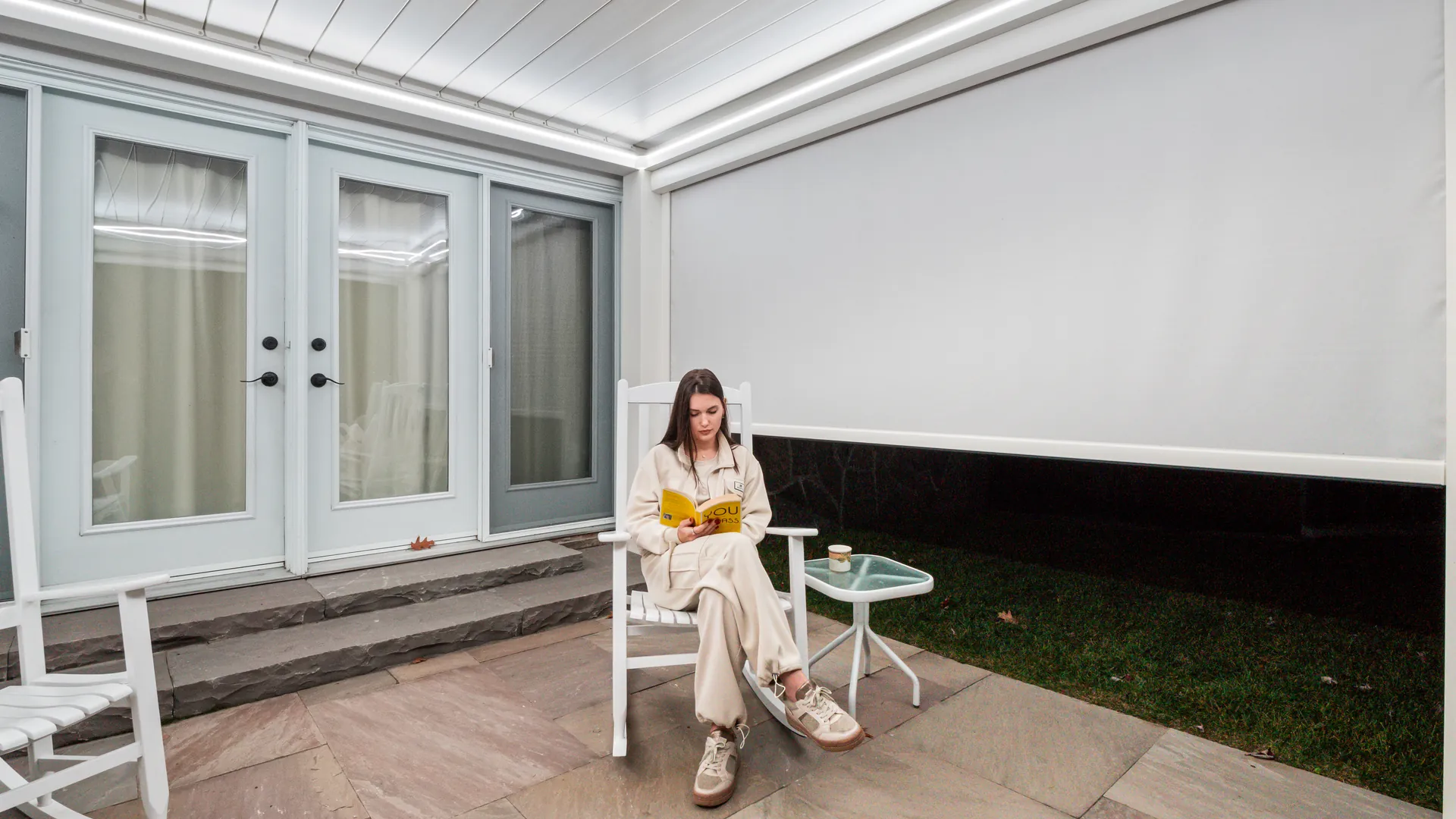
Example: A Hot-Tub Pergola Used After Dark
The hot tub site should be evaluated at night when privacy may be most critical.
Verify:
- the screen visibility from outside with the pergola lights turned on;
- the closest sightline from the exterior;
- whether silhouettes can still be seen;
- whether you need to add an additional opaque barrier on one side.
If there is a need for a solid visual barrier, then consider installing screens with an aluminum privacy wall.
Example: An Outdoor Dining Space With Afternoon Sun
A west-facing dining space might be acceptable in the middle of the day but could become an issue after some time because the sun will sink below the level of the roof.
Consider the direction of low-angle sunlight, glare to your eyes from the seat, the view you wish to preserve, and how frequently the screen will move. The guidelines by Health Canada on extremely hot weather encourage people to seek the shade and minimize direct sun exposure.
According to LOUSOL, the claims of the fabric supplier about Soltis® Veozip blocking up to 96% of UV radiation should be considered product specifications.
Example: A Multi-Screen Commercial Pergola
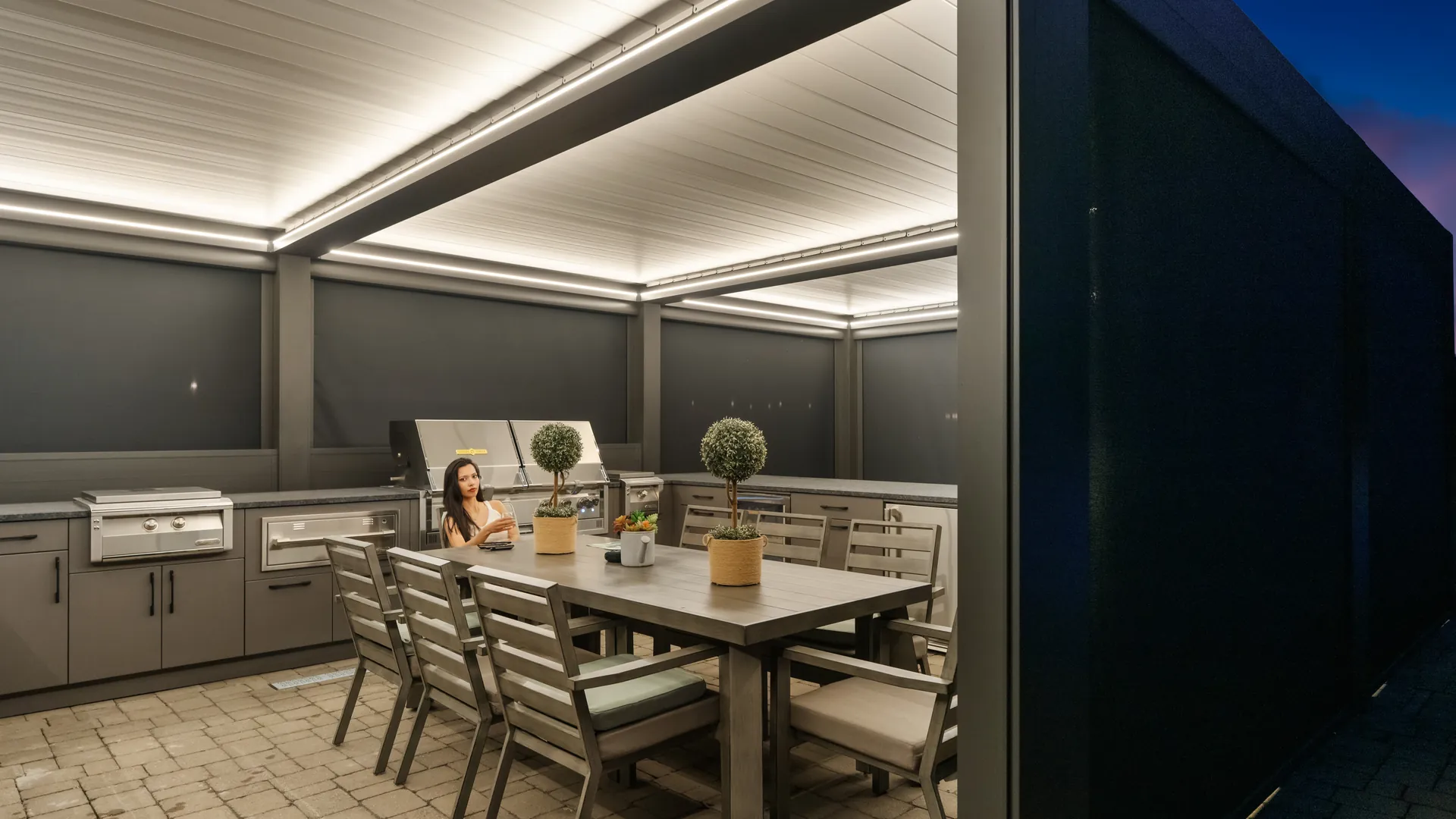
If a restaurant or hospitality facility uses a pergola, staff may need to move more than one screen based on changes in the sun and environmental factors.
Take into account:
- the number of screens that will be moved;
- whether they need to be moved in unison or not;
- access to controls by the staff;
- power and cabling;
- coordination with light and louver controls.
The LOUSOL motorized screens can be programmed individually or controlled collectively. Where more than one screen will be operated frequently, emphasize the ease of control and groupability of the system.
See LOUSOL’s recent pergola projects for real residential and commercial installations.
Common Mistakes When Choosing Pergola ZIP Screens
Quick Answer: The first error is taking privacy to be absolute, motorization without having assessed the screens’ use case, and ordering without verifying sizes, mounting situations, and power availability. Evaluating the fabric under perfect daylight is another frequent error. The best procedure would start with assessing the use case, followed by checking the fabric, lighting, size, control, and compatibility.
ZIP screen effectiveness depends on clear-cut expectations. The problem arises when a customer expects a certain characteristic of the screen to cover more than is actually stated in the specification.
Assuming a Privacy Screen Is Fully Opaque
5 percent transparency does not equate to 100 percent privacy.
Don’t make these erroneous assumptions:
- “If I can’t see in during the day, no one can see in at night.”
- “A privacy screen is the exact equivalent of a solid wall.”
- “Transparency translates directly into a privacy percentage.”
- “The outcome looks the same from all viewing distances and angles.”
Privacy is dependent on the light balance on both sides of the screen. Usually, the lighter side tends to be more visually dominant. View distance, angle, background contrast, and interior lighting matter as well.
If your patio is for evening use, try with the lights on. If it’s for a hot tub, take into account the actual sightline outside. For a pergola facing the street, consider pedestrian traffic.
Refer to it as a “privacy screen” as a functional description, not a guarantee of total invisibility. This makes it easier for customers to purchase properly and prevents disappointment afterward.
Choosing Motorization Without Considering Actual Use
Motorization provides convenience when it fits the user’s needs. It cannot be beneficial in all projects automatically.
There are two errors made by people that contradict each other:
- specifying motorized controls for a screen that will remain in a lowered state for days and will not need adjusting;
- using manual controls for a number of screens that staff or homeowners are going to adjust every day.
Before making your choice, calculate how often a particular screen will move during an average week and how many screens one person will operate.
Make the same calculation considering a seasonal use of screens. If the screen is used mostly during summer afternoons to protect from the sun, it may be controlled very differently from a screen used year-round for privacy. The more frequently conditions change during the period the space is used, the more important it is to have fast adjustment options. But if the screen is going to remain in the same position for a long time, it might not need any complex control system just because the motorization is possible.
If the answer is “sometimes, one screen,” a hand crank might be the perfect solution. If the answer is “several times a day for three or four screens,” then a motorized control system becomes more reasonable.
Ordering Before Confirming Size, Power and Compatibility
A ZIP screen is a tailor-made system, not just a regular curtain. Order too early, and you may run into issues with track installation, cassette placement, electrical requirements, or how the screen relates to the pergola structure.
Before ordering:
- Check the actual clear width and height.
- Check where the side tracks will be mounted.
- Check whether there is enough room for the top cassette.
- Check if the existing pergola is suitable for the screen system.
- In case of motorized screens, check availability of permanent electricity.
- Check locations of controls and desired performance of grouped screens.
- Check the entire design layout before manufacturing.
LOUSOL provides a range of screen sizes of roughly 4 to 20 feet in width and 4 to 14 feet in height. That range is a good starting point, but you should confirm the existing structure fits your project needs.
When you plan a pergola with the LOUSOL system from scratch, consider the 10’ x 12’ pergola kit and other pergola layouts alongside accessory requirements.
Expert Tips: How LOUSOL Assesses a ZIP Screen Setup
Quick Answer: A practical evaluation of the ZIP screen involves taking the entire case study of how the pergola will be used, i.e., what you want to protect or preserve, which sides are exposed, opening size, frequency of movement, availability of power, and integration of the screen with the pergola itself.
LOUSOL designs residential and commercial louvered pergolas and offers ZIP screens as an integrated accessory. That experience is most useful when it is applied as a selection method rather than a sales claim.
LOUSOL’s Screen Selection Criteria
A comprehensive review process would include the following criteria:
- Overall purpose: privacy, sun, glare, bugs, side exposure, or multi-purpose.
- Direction of viewing: what needs to be hidden and what needs to remain visible.
- Timing of use: day, evening, or both.
- Side exposure: direction of the sun, wind, and sight lines.
- Screen size: clear opening width and height.
- Number of screens: single side to solve one issue or multiple sides.
- Frequency of adjustment: occasionally, daily, or several times during the day.
- Method of operation: manual, remote, smartphone app, or voice commands.
- Access to power: for automatic screens.
- Compatibility with a pergola: an integrated design solution or a retrofit.
- Integration aesthetics: color of the screen and its coordination with the louvers and surrounding architecture.
This isn’t an engineering standard; it’s a decision-making process based on the variables influencing how you’ll use the screen.
LOUSOL’s ZIP screen product page is the right place to examine current fabric, color, size, and control options.
Use the “If X, Prioritize Y” Decision Shortcut
When several considerations are involved in the decision process, these conditional rules could help you decide:
- If privacy during the night-time is your main consideration, focus on real-lighting evaluation.
- If frequently changing conditions are important, consider motorized controls.
- If electricity is scarce, choose manual control.
- If more than one screen should be moved at once, choose motorized controls for groups.
- If outside view is essential, evaluate the fabric visibility and avoid adding screens on all sides.
- If you’re adding the screen to a pre-existing pergola structure, confirm compatibility first.
- If low sun is the main issue, focus on the exposed side rather than assume the necessity of enclosing all sides.
These are conditional rules indeed. They help you make a choice by focusing on certain priorities instead of presenting one option as a universal solution.
LOUSOL expertise will be most useful at the verification stage: the combination of required use and possible screen sizes and controls, and also the structure of the pergola itself. The homeowner, for instance, may have an idea of “privacy” in mind; however, the final choice depends on which side to screen, when privacy is needed, whether the outside view should be preserved, and how often the screen will be moved. Thus, the general concept becomes project-specific criteria.
Verify the Configuration Before Ordering
This final checklist must be considered prior to fabrication of the screen:
- Verification of primary use case.
- Verification of actual sides requiring screens.
- Verification of clear opening size.
- Verification of material and visibility requirements.
- Verification of screen color.
- Manual or automated mechanism verification.
- If automated, verification of power and controls.
- Verification of whether more than one screen should be grouped.
- Verification of pergola compatibility.
- Verification of warranty and maintenance details.
- Confirmation of final design by the project team.
In relation to ownership considerations, LOUSOL says that ZIP screens should be cleaned using a wet sponge or cloth along with a non-abrasive, water-based household product. Screens that operate automatically should first be switched off before they are cleaned. The company has also recommended not using screens when there is ice or snow present in the system.
Refer to LOUSOL warranty and product guidelines for current information.
ZIP Screen Specifications and Statistics That Matter
Quick Answer: Useful data includes numbers that have any effect on the decision. LOUSOL states that Soltis® Veozip should have 5% translucency, width about 4-20 feet, height about 4-14 feet, a ZIP screen with a 5-year warranty, and Somfy motorization with a 2-year warranty. Also applicable: Canadian UV guidelines, if side sun is an important factor.
A specification should always be read with its limitations. Transparency is not a privacy percentage, and a published size range does not automatically prove compatibility.
| Statistic / Specification | Source | What It Means | Limitation |
|---|---|---|---|
| 5% transparency | LOUSOL | Semi-transparent fabric with outward visibility | Not a fixed privacy percentage |
| Up to 96% UV blocking | Fabric manufacturer claim via LOUSOL | Relevant to solar control | Not complete personal UV protection |
| Approx. 4–20 ft width | LOUSOL | Published planning range | Compatibility still required |
| Approx. 4–14 ft height | LOUSOL | Published planning range | Compatibility still required |
| 5-year frame/fabric warranty | LOUSOL | Ownership planning | Review full terms |
| 2-year motorization/electronics warranty | LOUSOL | Motorized ownership planning | Applies to specified components |
| UV Index 3+ | Government of Canada | Increased need for sun protection | Varies by time, place, and weather |
LOUSOL First-Party Specifications to Use
Verified specifications include:
- Veozip fabric by Soltis®;
- 5% transparency;
- up to 96% UV protection according to the manufacturer’s claims;
- width of 4 to 20 ft and a height of 4 to 14 ft;
- Graphite Black, Natural, Sea Lion, Gray Pepper and Frost White;
- hand-crank manual control without electricity;
- Somfy-driven motorized operation;
- remote, smartphone app, and Google Assistant control options;
- operation of single or multiple screens;
- 5-year warranty on frame and fabric;
- 2-year warranty on Somfy motorization and electronics.
ZIP Screen for Louvered Pergola web page contains up-to-date information about the product.
Instead of asking which specification value is the highest, the question is which specification affects the decision? If one buys a blind for evening privacy, he should think about transparency and light in particular. For several frequently adjusted sides, it is better to start with control and electrical installation considerations. A retrofit project will make dimensions and mountability the key features rather than colors.
Canadian Sun, Shade and Outdoor-Use Data
Environment and Climate Change Canada categorizes the UV index as low, moderate, high, very high, and extreme and mentions that the risk of exposure in Canada is highest between 11 a.m. and 3 p.m. and between April and September. It further mentions that shading reduces UV exposure up to 50% or even more.
As for insect exposure, the Public Health Agency of Canada provides screening as a physical barrier and advises fixing any gaps. Its guide on West Nile prevention advises using screens on windows and doors. A pergola is not an enclosed area, but this logic should be taken into account anyway.
How to Interpret Claims and Limits
Maintain a clear line between the following categories:
- LOUSOL specs: transparency, size, colors, controls, and warranty.
- Fabric producer specs: performance due to the fabric.
- Government advice: information on UV protection, heat resistance, and insects.
- Project-specific conclusions: whether a given design is appropriate for a certain pergola.
Avoid calling a pergola “95% private” when it has 5% transparency, assuming compatibility because the size is published, and making a health promise based on the fabric’s UV protection.
Case Study: A 14' × 40' Pergola With Motorized Screens
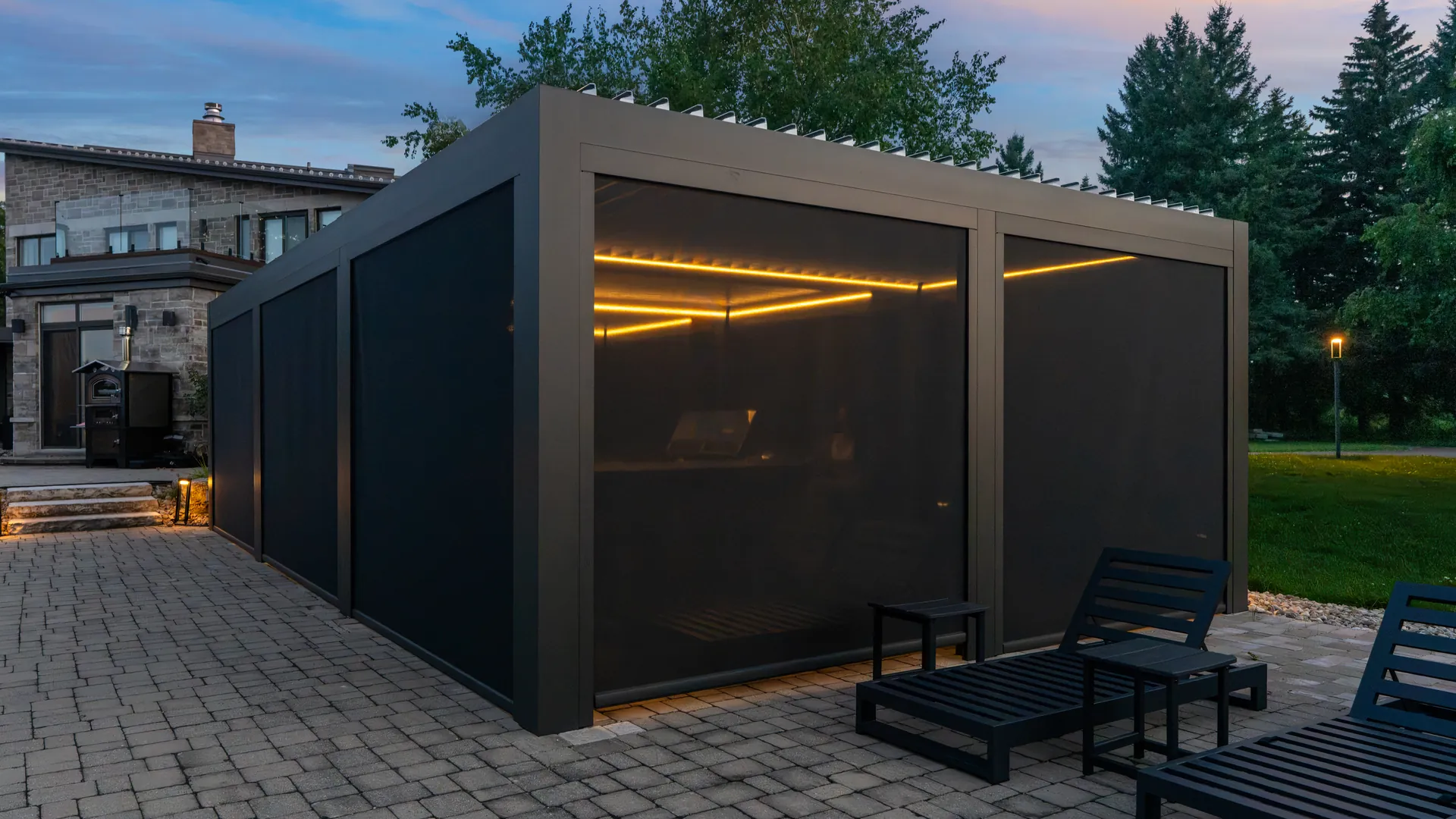
Quick Answer: In a true LOUSOL case study in Etobicoke, Ontario, you can see how ZIP screens can be incorporated into a large custom pergola instead of being treated as another separate accessory. This particular case study is about a documented 14’ x 40’ installation that features a Grey Umbra pergola frame, Pure White Louvers, a louver roof, ZIP screens, and warm LED lights.
The LOUSOL project library includes pergolas for residential and commercial use, with both manual and motorized screens. An informative example of such a project can be considered the 14’ × 40’ pergola with screens in the backyard in Etobicoke. The website provides enough information about the screen system configuration without showing customers the final result.
Project Configuration
Project description includes the following:
- Location: Etobicoke, Ontario
- Pergola size: 14’ x 40’
- Color of frame: Umbra Grey
- Color of louver: Pure White
- Roof: Motorized
- ZIP screens: Motorized
- LED lights: Warm
This project configuration is valuable as an example in terms of combining a large pergola space with motorized control of the roof and ZIP screens.
However, the information provided by LOUSOL about the project does not include the client’s personal decision-making process, the number of screens used, their color, and measurements of any improvements made to the comfort level. All of this cannot be considered and analyzed.
This matters because the project shows the company’s ability to build the pergola, but it doesn’t show how well that configuration would work in another location. The important information here is the combination of size, motorized louvers, screens, and lighting. Another project requires a separate evaluation in order to choose the same configuration.
The only thing proven by the project page is that LOUSOL has constructed a motorized ZIP screens pergola of 14’ x 40’.
What the Configuration Shows About Control Planning
With these dimensions, the motorized screens are part of a wider motorized outdoor system that also involves the louver roof. This project justifies using control planning as an example of why it’s essential on large-scale construction, but not to explain why the client chose motorization.
In the case of a similar project, the buyer needs to consider:
- How many holes should the screens have?
- Should all the screens operate simultaneously or separately?
- Will the pergola be changed throughout the day?
- Where can connections for power and motor be made?
- How does the operation of screens relate to the operation of roof and lighting?
- Which sides need privacy, shading, or insect protection?
The point here is not that all large pergolas must use motorized screens. The point is that once you combine multiple adjustable elements, you need to plan control for the entire system, not each component individually.
What Buyers Can Learn From the Etobicoke Project
There are three concrete conclusions that can be derived from the described configuration.
First, it is possible to install ZIP screens in a custom-made pergola in significant numbers. Second, screen motorization can coexist with louver motorization and integrated LED lighting. Thirdly, finish selection, such as an Umbra Grey frame and Pure White louvers in this particular case, is a part of the whole visual composition and not a stand-alone screen choice.
For those who plan to have a similar construction:
- consider actual projects before selecting colors;
- try planning screens in the pergola design phase if possible;
- consider all the electrical needs before installation;
- select which components should be motorized;
- define screen configuration for each opening.
Recent LOUSOL projects can be sorted by motorized and manual ZIP screen configurations, making it easier to compare real-life applications without generic samples.
Conclusion: Build Your ZIP Screen Decision Checklist
The ideal ZIP screen configuration will solve the correct problem with minimal undesired compromises. Retractable pergola screens should be selected around the way the opening actually needs to change during the day, so always start with your use case rather than the motor or fabric color.
Use this checklist for your final decision:
- Determine your primary objective: privacy, side sun, glare, insects, side exposure, or combined purposes.
- Determine the level of outward visibility you wish to preserve.
- Analyze your privacy needs based on real-world day and nighttime light conditions.
- Identify the pergola sides that need screens.
- Measure clear opening size and verify structural suitability.
- Choose manual or motorized based on adjustment frequency, number of screens, and power availability.
- If motorized, verify the electrical and control solution prior to fabrication.
- Consider fabric color based on the entire pergola design.
- Analyze warranty and maintenance details.
- Verify the final configuration for the particular job.
The choice of fabric, privacy, and control mechanisms needs to happen together. The change of one element may affect the value of other elements.
When evaluating your options based on an existing or planned pergola, please consider the current pergola ZIP screen specs as well as custom pergola solutions from LOUSOL. For project-specific configurations, our team will help verify opening sizes, structural suitability, and the proper manual/motorized configuration before fabricating the screens.
Frequently Asked Questions About Pergola ZIP Screens
How does a ZIP track keep the screen fabric aligned?
The edge of the material is run through enclosed aluminum side tracks while the screen is moving. This ensures pergola privacy screens maintain fabric tension, limit side gaps, and reduce movement compared with a loosely mounted roller blind, while still retracting vertically.
What happens to the fabric when a ZIP screen is fully raised?
In the raised position, the fabric is wound in the upper cassette, which differs from the exposed fabric in a loose roll-down blind. With LOUSOL ZIP screens, the cassette provides additional protection of the fabric from dust and dirt in addition to maintaining a clean look of the pergola opening.
Is slight waviness along the side rails normal?
Yes. Some slight waviness of ZIP screen fabric around the side rails can be noticed, especially for more rigid technical fabrics. This could be due to how the fabric is guided, and it is normally considered a normal feature, not damage to the fabric.
Are horizontal marks on ZIP screen fabric a defect?
No, not necessarily. These marks could appear at the point of wrapping of the fabric on the roller shaft or where the seams of the fabric touch the rolled fabric. With retractable pergola screens, these marks would still be visible even when the screen is lowered.
Can the bottom weight bar bow on wider ZIP screens?
Certainly, the bottom bar can bend on very wide screens and cause fabric waviness on the sides. However, the extent of the effect depends on the size of the screens and needs to be taken into account while designing larger openings.
Can ZIP screens be used on covered patios as well as pergolas?
Certainly, as per LOUSOL, custom ZIP screens can be installed with louvered pergolas, aluminum pergolas, patios, and other covered outdoor spaces. The primary condition is a suitable opening and adequate space for the installation of cassette and side tracks.
Do ZIP screens make a pergola fully weatherproof?
No. While outdoor ZIP screens can help reduce direct sun, insects, unwanted visibility, and some side exposure, a pergola remains an open-air structure rather than a sealed room. Wind-driven rain, changing weather, and other open areas can still affect comfort.
How are ZIP screens different from standard roll-down outdoor blinds?
A ZIP screen ensures that the edges of the fabric stay enclosed in side channels while operating up and down. The key difference is that the fabric edges stay guided on both sides, preventing unnecessary shifting during operation.
Can a lowered ZIP screen still allow airflow?
Yes. Technical screen fabric is engineered to offer protection and privacy without behaving like a solid wall. Air circulation through motorized pergola screens is possible, although it depends on factors such as fabric type and weather.
Will ZIP screen hardware look bulky on a modern pergola?
The visible parts consist of an upper cassette, side guides, and a bottom rail. The company LOUSOL manufactures its hardware from aluminum designed for combination with modern pergola systems; however, the appearance will depend on the size of the opening, the color of the framework, and positioning.
Checkout more
helpful articles
Manual vs Motorized Pergola ZIP Screens
How manual and motorized pergola ZIP screens compare on controls,...

Pergola Installation vs DIY: Which Saves You Money?
When DIY pergola installation genuinely saves money, when a professional...

Restaurant Patio Covers That Increase Revenue
A practical framework to estimate how much revenue a covered...


Best DIY Aluminum Pergola Kit Features
The features that make a DIY aluminum pergola kit easy...
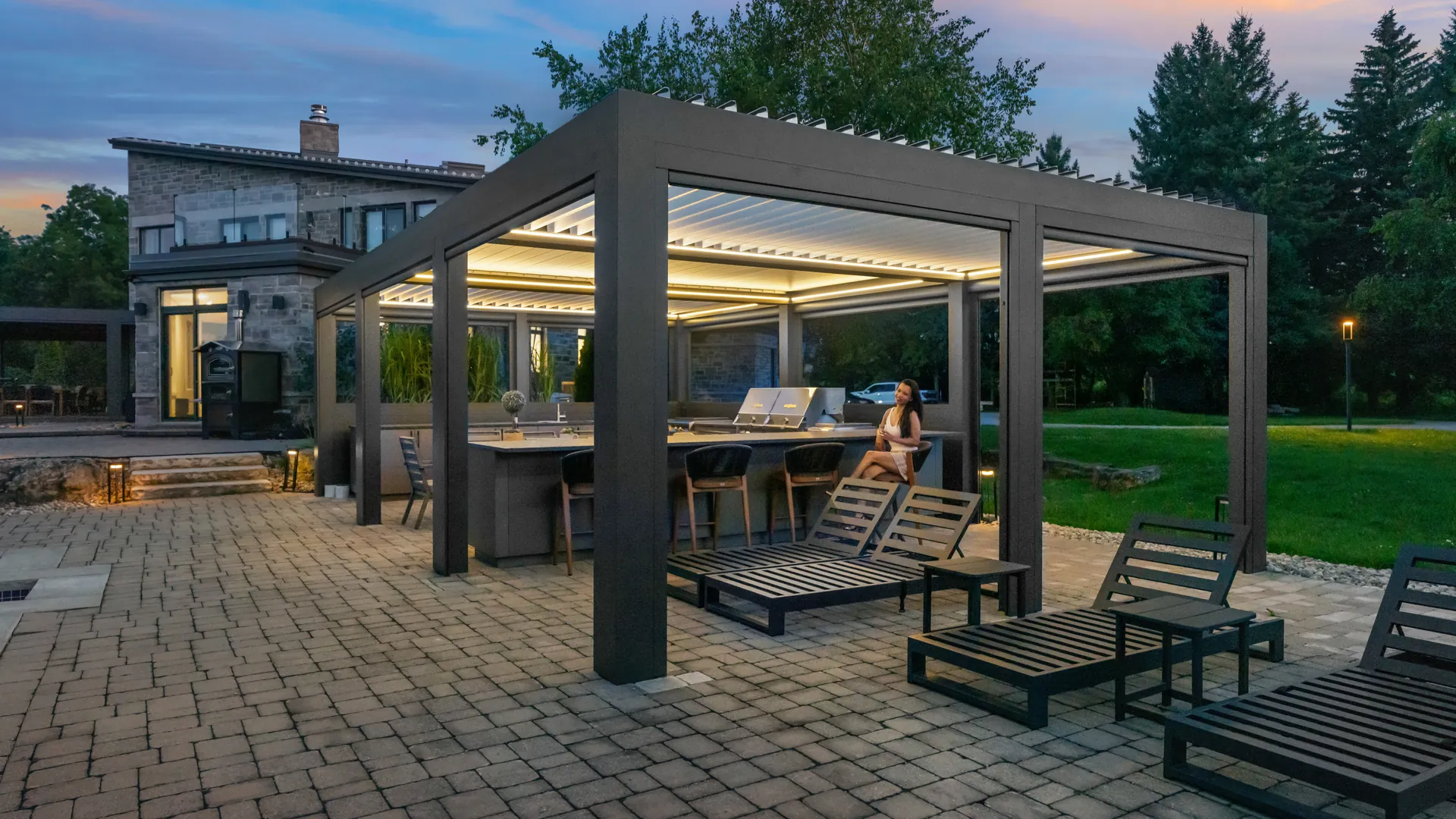
How to Plan a Custom-Size Aluminum Pergola
How to plan a custom-size aluminum pergola: measurements, footprint, post...


